
When I was a kid, I read a lot of books. This had the result that somewhere around second or third grade, I had an unending stream of first-person narration running through my head at all times, describing all my actions and thoughts in the past tense, just as they happened e.g. “I stalked toward the jungle gym, thinking furiously of Brittany Whitmore and her treachery in turning the Secret Girls Club against me.” The whole thing was tremendously embarrassing, though fortunately only to me.
Rolling Deep, having taken on a rubber-hose Journey to the Center of the Earth theme, has reawakened that tendency, only now the narration is written by Jules Verne: “She descended deeper into the volcano, her provisions dwindling and her prospects uncertain.”
Translation: I was one coin short of buying the card I wanted.
Or: “The situation was hopeless, but she pressed on, having several turns ago mistaken hope for probability.”
Or: “The success of the mission now depended upon a single favorable outcome.”
Translation: I needed to roll a five.
This was followed shortly thereafter by:
“She did not roll a five.”
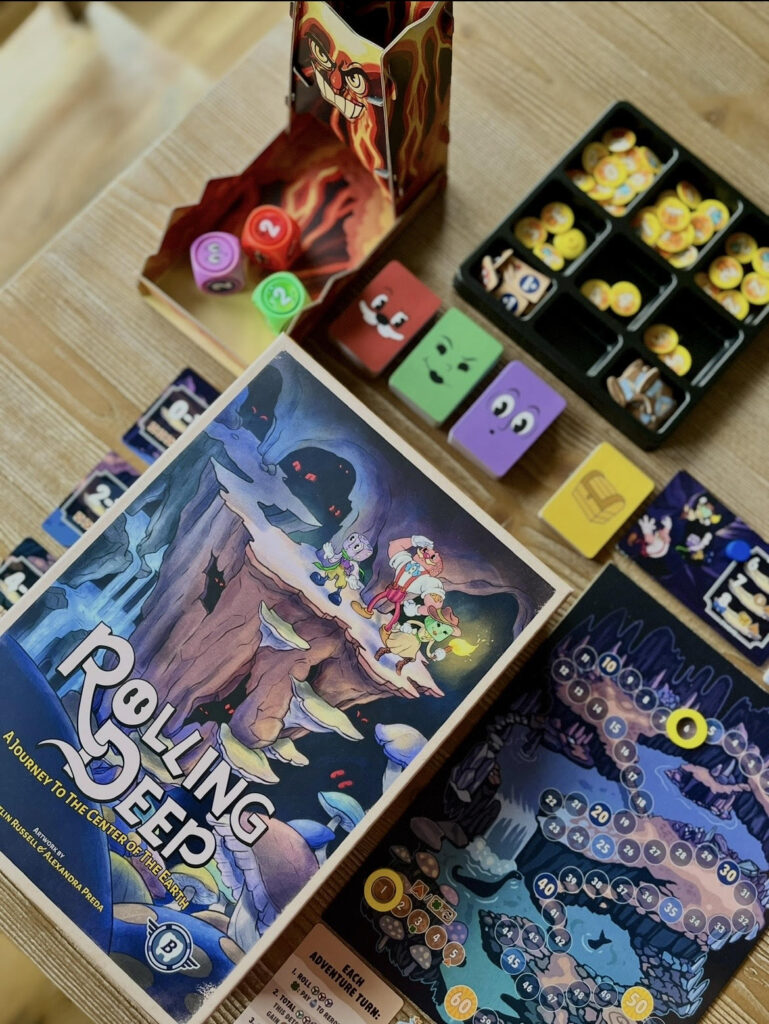
That’s part of the charm, and charm this game has. It made me crave what I didn’t know I had the capacity to want: not wealth or glory but the perfect run. A run where the dice do what I want them to do, the shop opens its little glorious heart to me, and the combos wambo.
When they say this game is addictive, they’re not foolin’ around here. Prepare yourself. Dismiss all responsibility from your life for at least several weeks. If you have laundry, make peace with it. If you have a job, quit. If you have kids, the mines (it’s ok, it’s only for a few weeks; besides, they yearn). Do whatever you need to do because you’re not gonna want to stop.
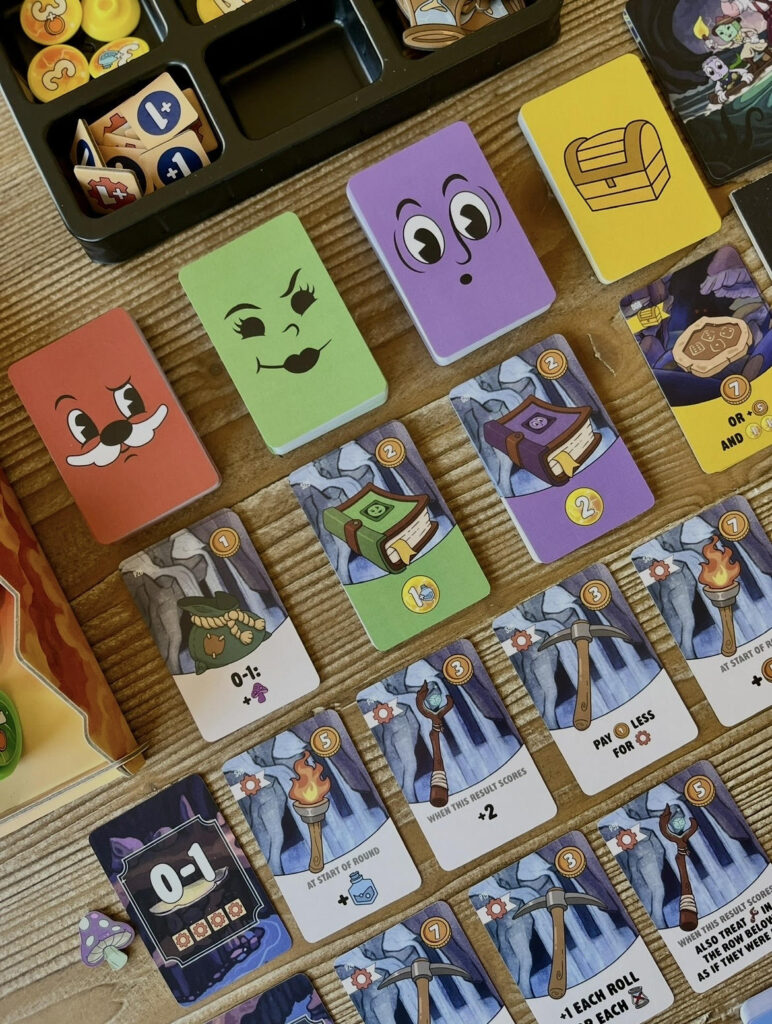
So here’s how you play this Balatro-Cuphead-center-of-the-earth journey. You lead a trio of daring dice-headed adventurers into a volcano (this sentence alone makes me love board games). Each character has their own die and their own deck of cards, and those dice begin with simple, prescribed faces before the game starts handing you all sorts of fun things.
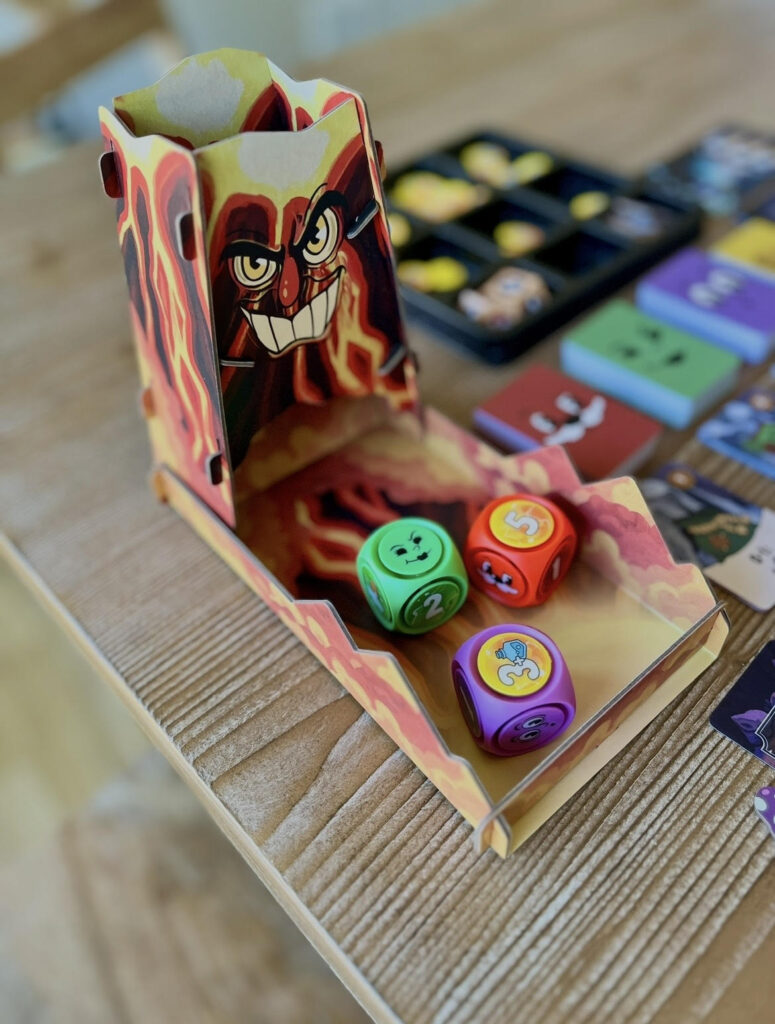
Each round gives you a target number to beat. You roll your three dice, decide whether to score the result, or spend reroll potions to reroll individual dice and try for something better. When you score, that number moves you toward the target. Hit the target before time runs out (aka the number of chances you have before the round ends) and you survive. Fail, and your brave expedition ends then and there.
Fortunately, resetting for a new run is quick. In just a few minutes, everything is back where it needs to be, and you are free to make a completely new series of errors with confidence.
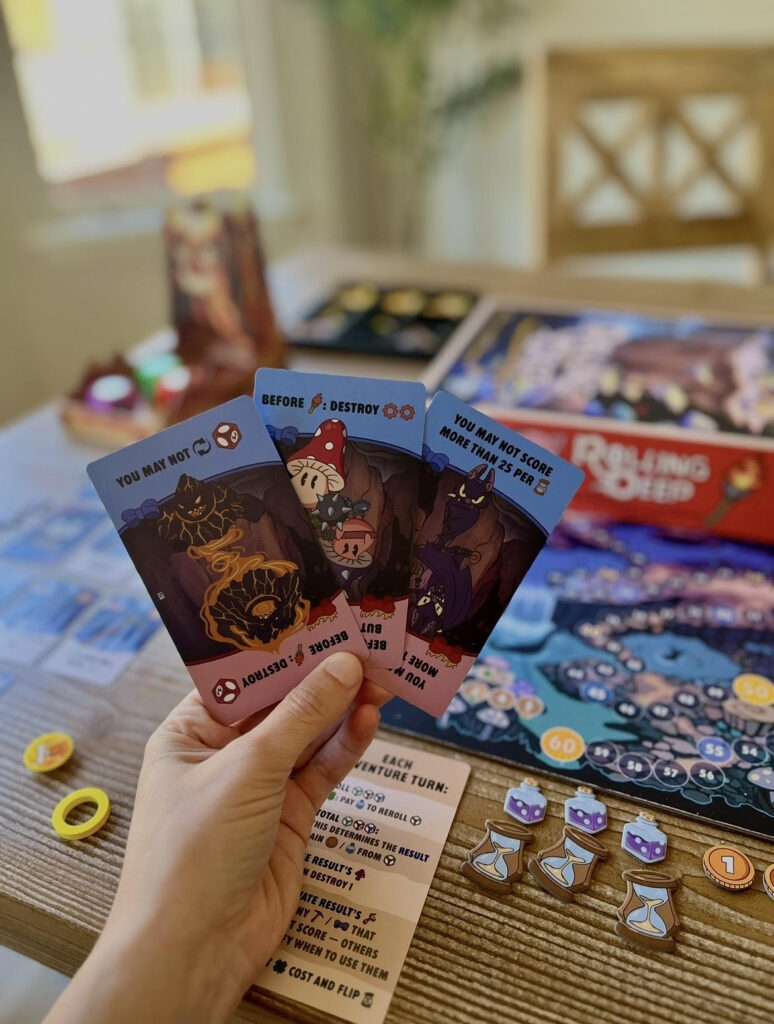
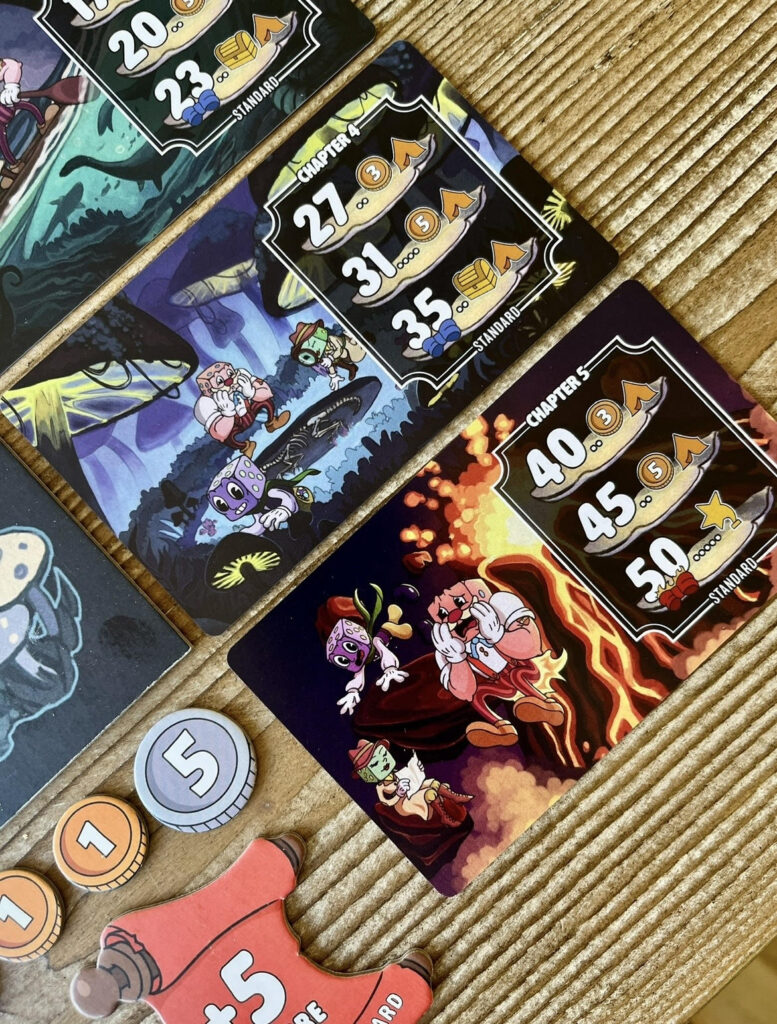
The game is divided into five chapters, with each chapter asking for higher and higher scores before ending in a boss encounter that changes the rules in some horrible little way. One boss might stop you from scoring 1’s. Another might prevent you from rerolling a certain die. If you’re especially unlucky, you’ll get one that targets the exact sort of engine you’ve built.
Between rounds, you visit the shop, which is my favorite part: a little tent of goodies where you’re tempted by everything. You draw cards from your adventurers’ decks and spend coins to buy equipment, consumables, and abilities. Some cards improve your dice faces, turning sad little zeros into useful numbers and/or resource generators. Equipment cards, meanwhile, get slotted into rows tied to your roll results. Put a card in the 2–3 row, and it triggers whenever your roll result is a 2 or 3. Some cards might give you a flat +1 to each roll, others might let you trigger cards in other rows, etc.
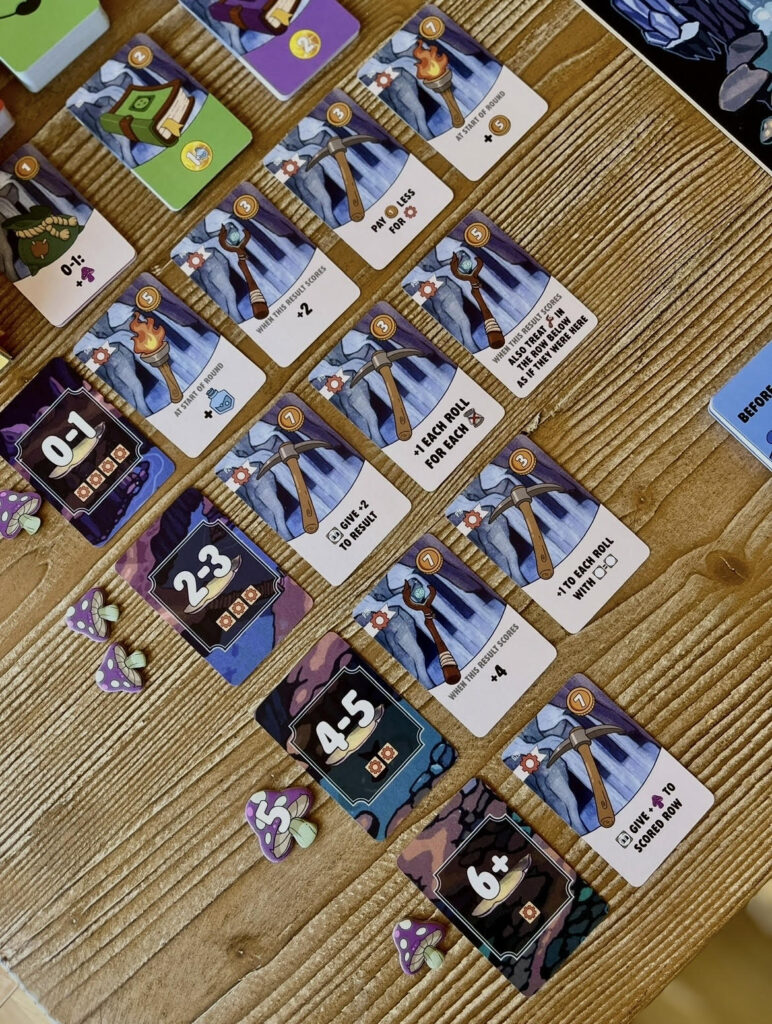
These results rows are the heartbeat of the game. Each row only has so much room, and you can’t freely rearrange equipment once it’s placed. You can destroy equipment to make space, but that means every placement needs to be considered seriously. This makes it a game of which numbers you want to roll often and what kind of cool little machine you can build around them, rather than “roll big number, feel smart.”
Side note here: If I had one critique, it’s that this is not a perfectly fused theme-and-mechanism situation. The results row tableau does feel like a tableau. You are very much looking at numbers, slots, and triggers rather than feeling like every single action is a literal step deeper into the earth. But that really didn’t bother me much. I’m not coming to Rolling Deep looking for a full sensory hallucination of volcanic spelunking. I’m looking for a great solo game with a fun theme, wonderful art, and enough personality to make all that machinery feel alive. And on that front, it happily provides.
Now, back to it. This choice of card placement is a huge part of what makes Rolling Deep so replayable. Each of the three characters has a 50-card deck, and in a full run you’ll only see about 30% of those cards, maybe more if you can afford shop refreshes. So while there are absolutely strong builds to chase, the game rarely lets you stroll into the shop with a five-year plan. You have to make the cards you actually see work for you. If you want to dig through the deck faster, you need an economy. If you want an economy, you need the right cards. If you want the right cards, well. Welcome to the volcano.
Flexibility is also a huge part of each run. Early on, I’m usually not scoring 6+ often enough to trigger that row reliably, so I can afford to leave that space open and see what the run becomes. Maybe later I’ll find the perfect card for it. Maybe I’ll build around low rolls instead. Maybe I’ll finally become an optimist in a dice game because I can finally believe in those damn dice for reasons other than my own personal delusions.
The goal of each run is to survive the five chapters, reach the volcano’s core, defeat the final boss, and escape with treasure and glory. And if you’re really good, there’s an Advanced mode with higher point thresholds. It took me 7 attempts to win my first run on Standard. And based on what’s in the super secret “Win A Game: Unlock!” box, that was just the beginning.
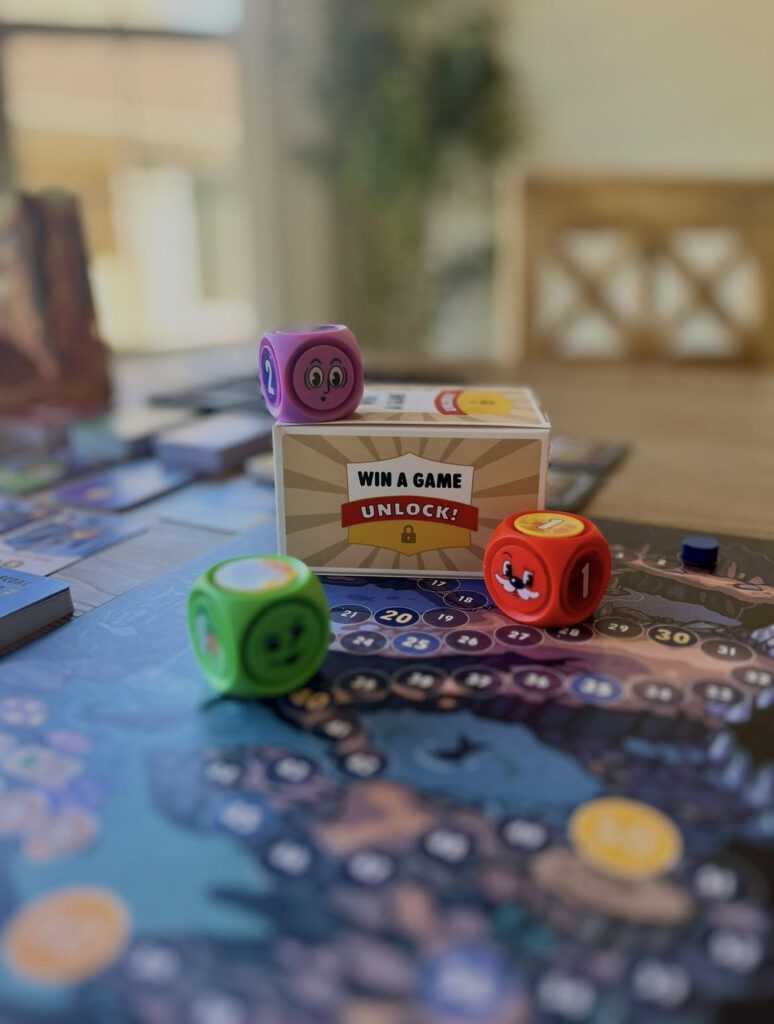
There is a LOT to unlock. Let it be known there will be no spoilers here, but I did have to spoil a few things for myself because I literally would not have been able to see everything the game has to offer before getting this preview out. There is some really fun stuff waiting down there, and I strongly encourage you not to look until you earn it, no matter how tempting it may be. If it helps, picture me appearing from nowhere with a spray bottle and administering one firm spray at your face to keep you from committing a crime against wonder.
Now, if you’ve played Balatro, you probably felt several little bells go off just now, maybe also followed by the sound of your responsibilities (laundry, job, kids) leaving the room.
Rolling Deep scratches a similar itch: the escalating thresholds, the unlocks, the engine-building, its “one more run” pull. But thankfully, it’s not trying to be Tabletop Balatro, which would have been the obvious and less interesting road. It borrows the shape of that good time, but not the substance. It feels a little like discovering Balatro again from a different doorway: similar enough for the part of my brain that likes combos and unlocks, but different enough that I had to learn its tricks on its own terms.
And that, I think, is why the game works so well. It’s not just telling you to roll your dice and hope. The game wants you to build better luck, one die face and one card purchase at a time. It’s forever hinting that something else lies just below the surface: another card, another possibility, another reason to descend once more.
There really isn’t much out there quite like it. Rolling Deep belongs to a very small category of games for me: the handful each year that feel genuinely special. It’s special because it’s possibly the most fun I’ve had playing a solo game. “Fun” might sound like faint praise, but I submit that fun is not the least serious thing a game can offer. It may be the most serious. I’ve been impressed by cleverness before and then left it behind. Delight is what sends me back to the table. And Rolling Deep is delightful.
Man, this game is good. I’m looking at it right now and feeling the urge to pop off another die face just for the heck of it. I wish I could better express how great it is to build my precarious little engine of cards and send the whole fragile contraption into the earth to see if my handiwork survives.
Obviously, you will still fail now and again. Your little engine might be scattered across the cavern floor. But before the smoke has cleared, you are already looking at the next unlock goal and thinking the oldest, noblest, and most foolish thought in gaming:
This time, surely.
Thank you very much to Bitewing Games for the prototype provided for this preview. As a prototype, everything is subject to change.