
I have severely limited spoilers here, as this is a game that benefits enormously from not knowing what’s coming, but know there are some vague references and spoiler markers for the early chapters I’ll discuss.
Tolkien is the greatest guy I’ve never met and The Lord of the Rings makes me feel excited, instead of burdened, to have been born a human being. There are certain things I am quite sure I would do if called upon to save Middle-earth. I would stand before the Black Gate. I would ride with the Rohirrim. I would DEFINITELY carry the Ring into Mordor. I know this because I’ve never been asked to do any of them.
I guess that could be why we like to imagine courage in its most dramatic forms. Things like a hopeless charge and a last stand against an enemy forty times your size. It’s much easier from your couch. The Return of the King has no shortage of these and if you were looking for material for a motivational poster, Tolkien has kindly provided several thousand pages for you.
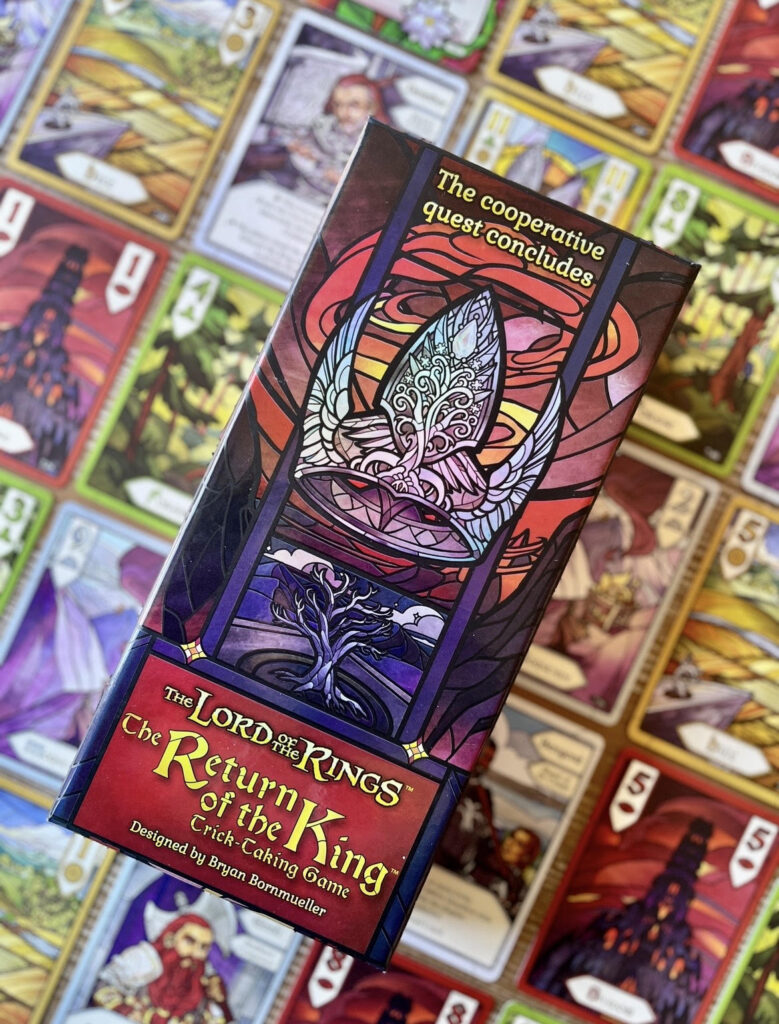
But I don’t think that’s really the sort of courage The Return of the King is about. Or at least, not only. And interestingly, playing The Return of the King: Trick-Taking Game made me think about that more than I’d expect a trick-taker ever would. And, to be fair, writing previews helps too because I sit here and think for a very long time. And, to be even more fair, I felt the same way about The Two Towers: TTG. But I feel that feeling even stronger now!
This is the third and final game in the cooperative trick-taking trilogy that began with The Fellowship of the Ring: TTG, and if you’ve played the first two, the basic loop remains familiar. Each chapter gives you a cast of characters with individual goals, and everyone has to accomplish theirs for the group to succeed. You follow suit when you’re able, manipulate who wins which tricks, and attempt to keep a poker face when your friend plays exactly the wrong card at exactly the wrong time (resentment is definitely an emotion you’ll feel playing this game).
But Return of the King: TTG has the unenviable job of finishing the thing. This is Return of the King. Armies are moving. Kings are returning. Hobbits are trudging toward the end of the world with, like, no second breakfasts. So no pressure. The game needs to get bigger while still being a trick-taking game, and it does.
The campaign opens in Minas Tirith, where one of the most important new ideas is the Crown. Cards can be placed beneath it through an action called Kneel, and those cards then affect character goals and future decisions. Pippin, for example, may kneel either 0 or 2 cards (swapping cards from his hand with cards beneath the Crown) and then needs each won trick to contain a card whose rank matches the rank of a card under the crown.
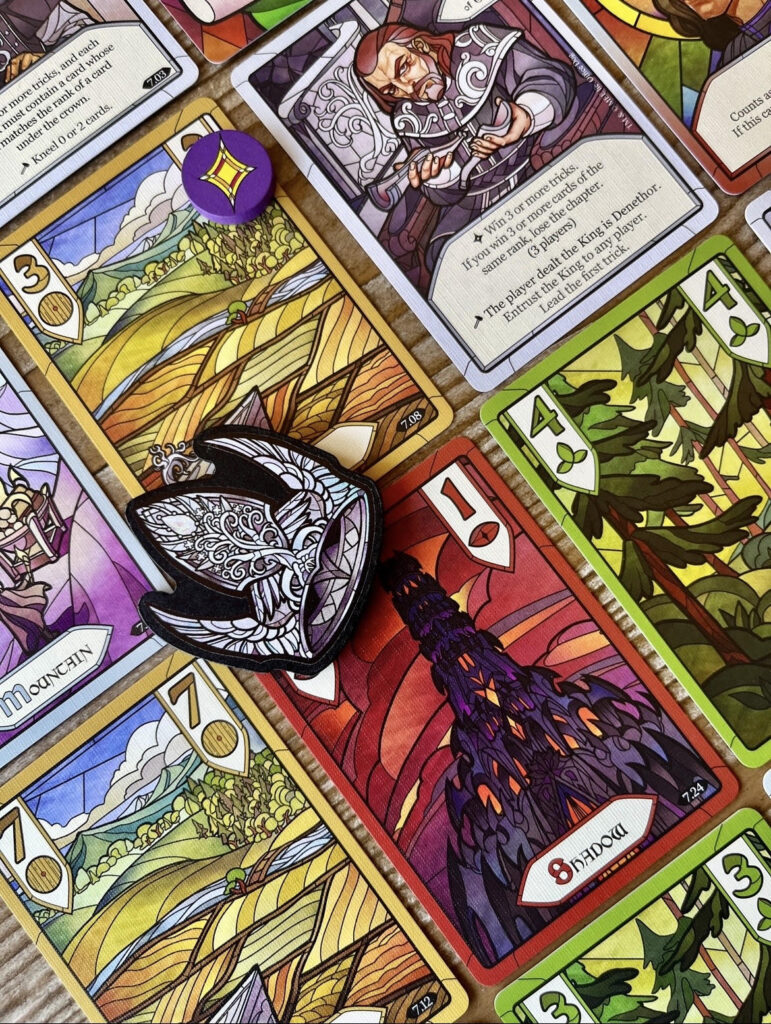
It’s a small thing, but I love it. Pippin has sworn his service to Denethor, and the game gives him an action literally called Kneel with the added little detail that his choice is all or nothing: two cards or none and anything you do is tied to that service now. There is no paragraph explaining this connection. The game just hands you the mechanic and lets you do what you will. That’s something this trilogy has become very good at.
Another early favorite of mine is The Paths of the Dead. This is the third chapter of the game, so I’ll put a SPOILER WARNING here in case you don’t want to see it.
The Oathbreakers appear as cards in each of the four suits, and when you play one, you decide whether it has a rank of 10 or 0. I like that much more than just making them crazy strong.
Here is this wild dead army, extremely powerful but not fully Aragorn’s, bound to him by an oath they once failed to keep. They exist for this one obligation, and then they’re gone. Their cards also feel outside the normal order of things. They can sit at either extreme of the deck, overwhelming a trick or fully losing it, depending on what the moment requires. Then, next chapter, they’re gone too. It doesn’t spell this out for you; you just get it by playing.
**SPOILER END**
That mechanical storytelling is one of my favorite things about this trilogy. It’s not that every chapter is some perfect marriage of Tolkien and trick-taking. It’s not, and I’m not sure any game covering this much story possibly could be. There are chapters where the characters and setting are less obvious and what you’re mostly doing is solving a fun trick-taking puzzle. Actually, I might even argue that The Two Towers hit that thematic bullseye more consistently.
I’ve played every chapter across all three games now, and they’ve kept making me want to set up the next one. Sometimes that was because I wanted to see how Bryan Bornmueller had translated a scene I had absolutely no idea how you’d turn into trick-taking. And sometimes it was just because the puzzle was fun.
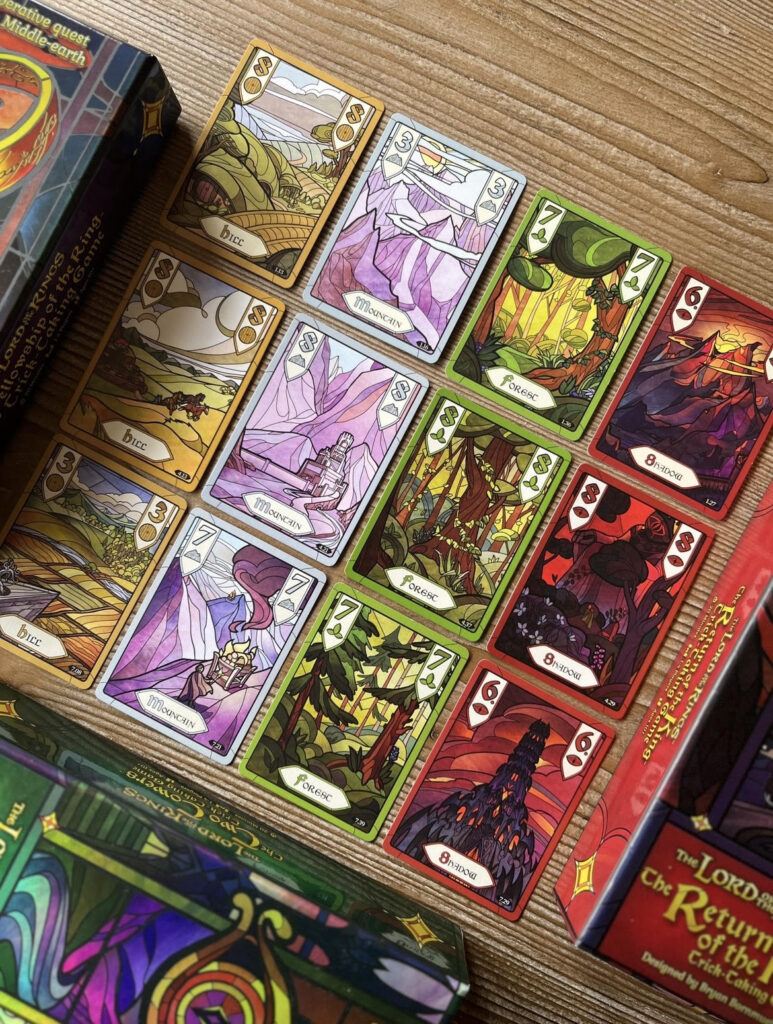
Taken as a whole, though, the trilogy does something pretty special: mechanisms you already know start meaning different things depending on who is using them. The King card is a good example of this. It’s rank 11 and counts as Hills, Mountains, Forests, and Shadows simultaneously. Very useful, and so naturally, the game spends plenty of time making you not want it.
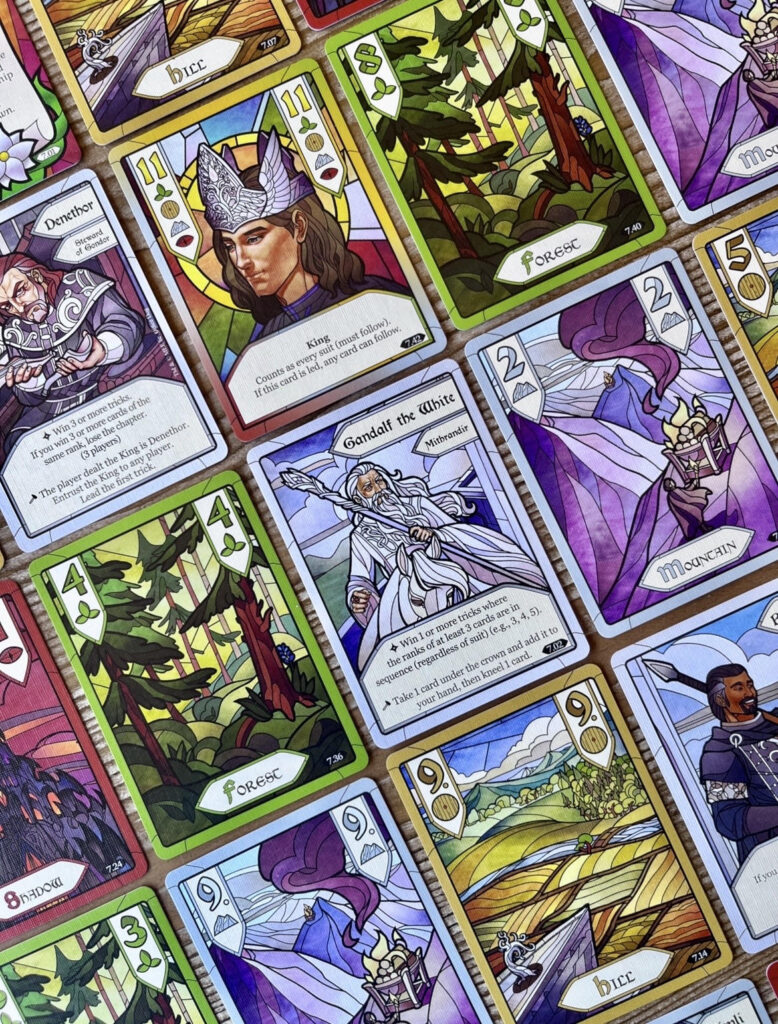
Different chapters make strength tricky to handle in different ways. Enemy cards can’t win tricks at all, or the round is over. Army cards are rank 0 and can still sweep in and win under the right circumstances. Merry can play the highest-ranked card at the table and specifically need not to win.
That’s because it’s not really a game about having the strongest card. And, conveniently for my tendency to overthink board games, neither is Lord of the Rings a story about being the strongest. Power is useful, sure, but knowing what to do with it is rather more useful. Something something King Solomon.
The third installment also contains some of my favorite character designs in the trilogy. I won’t tell you exactly what happens (I swears it on the Precious), but there are later moments where character’s state’s are reflected in a completely new way. You lose options and characters have to depend on each other more. There’s even some fun physical component surprises!
I think this is so clever and so great. I’ve talked about this in other reviews but so many narrative campaign games divorce the characterization from the mechanics. You read the thing, then play the game. Here, at maybe its best, the characterization happens from the restrictions themselves.
That also helps keep the bigger, harder-to-capture Tolkien ideas from feeling tossed in there afterward. For example, courage is sort of loosely on display by having to trust the other players. As far as I can tell, that’s kind of the best way to do it, especially once Frodo and Sam take center stage. It’s not that it’s courageous to play a card game, but it sort of manufactures the virtue.
I don’t want to wander too far into book review territory here, but one thing I love about Tolkien is that he doesn’t just let the good guys win because they were strong enough. Through the story, they were courageous, faithful, suffered, failed and showed pity when they couldn’t possibly know what that pity would accomplish. It was all important, especially that earlier pity towards Gollum.
There’s a sense of that in a cooperative trick taking world too. You’re trying to produce a specific outcome with information you don’t have aka what cards everyone is holding. You can’t just say what you need and the biggest card isn’t always the right card. Even winning tricks isn’t necessarily good, nor is losing them necessarily bad. You definitely have to rely on the other players to understand and read the situation similarly. Sometimes you play all your cards right but still need someone else to finish the job.
Am I trying too hard here? I don’t know, maybe. I’m not saying the game is secretly some grand philosophical treatise in card form. I promise I have retained at least some perspective. But it’s just really interesting to me how well this medium worked for telling this particular story.
It wouldn’t have been as good on its own. It already resonated with me because Tolkien already made us care about these things. The King isn’t just an 11 because we know what a king means here. The mechanics of the game don’t have to manufacture all that meaning on their own.
Speaking of emotional pull, something I strongly recommend is putting on the soundtrack while you play. We also houseruled through all three games that any time Arwen showed up we had to attempt the Elvish she says while summoning the water horses to wash away the Ringwraiths. Apparently the actual line is “Nin o Chithaeglir, lasto beth daer.” We went with “ninoninoninonino” which eventually morphed, with equal conviction, into
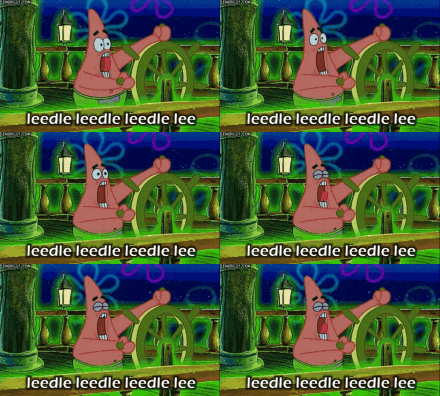
I think Tolkien would probably forgive us.
Ultimately, what I like most about this trilogy is that it tells The Lord of the Rings story in a completely different medium, and it does that with a real respect for the original. It also restored my somewhat agnostic faith in board game characterization. It finds all these little ways to point to why certain moments in the story were important. The world is saved by great deeds, but also loyalty, pity, and characters carrying each other farther than they could have gone alone. That a trick taker this easy to get to the table can carry so much Tolkien in it is, to me, pretty remarkable.
Thank you to Office Dog for the review copy.