
Ever since we stumbled out of a cave and lit a fire, our general goal has been to make life longer and more comfortable for ourselves. We invented medicines and indoor plumbing and fun stuff like ice cream and motorcycles, and by the 1960s, the life span and physical comfort of most Americans would have made most of human history green with envy. Of course, we haven’t always been terribly nice to each other in the process, but if you take the long view and compare it to humanity’s usual lot of disease, starvation, and dying in your 30s, things were overall pretty sweet. Most people slept indoors, ate nutritious meals, received medical care and education, and listened to terrific songs playing on the radio.
And I guess somewhere along the way, we also invented urban planning, a profession dedicated to making our lives more comfortable (or something) by deciding exactly where we are and aren’t allowed to put things.
I have no experience in this profession, although I do have some ideas about where the closest grocery store should be AND I’ve read The Power Broker (a true story about a city planner), which on its own should qualify me for some sort of government job because that book is like 1200 pages. Luckily, Downtown, the upcoming game from Robert Hovakimyan and Bitewing Games, has given me the opportunity to exercise my considerable expertise.
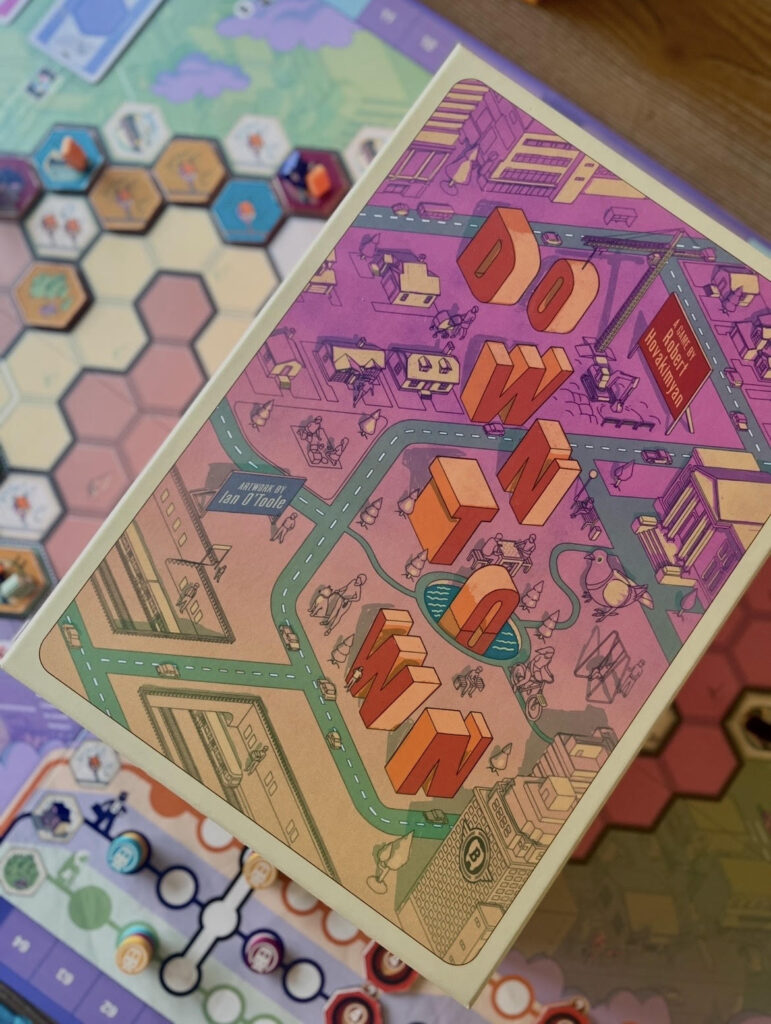
I’ve become pretty interested in Hovakimyan’s games. I absolutely loved Arribada, but Bebop didn’t do nearly as much for me. It’s an interesting design, no question, but I spent so much of my time calculating the things a die placement might do that I forgot I was supposed to be having fun.
Downtown has more in common structurally with Bebop than Arribada, which made me a little nervous. Thankfully, I found it much easier to get along with, though I do have a few notes. It’s smoother, the decisions feel more natural, and I’ve had a good time with it, particularly at three and four players. There’s a nice amount of interaction here, and I think it’s a much more approachable way to enjoy the sort of competitive design Hovakimyan seems drawn to.
We’re all building the same downtown on a shared board. Each round focuses on a randomly determined zone of the city, and players draw tiles from their bags, choose which to keep, and take turns placing them around town.
You’ve got houses, banks, parks, and subway stations. Houses form neighborhoods, and you’ll compete for majorities within them. Banks earn money from nearby buildings and can form financial districts. Parks score for neighboring houses and earn you park cards, which are pretty important unless you like negative points. And subway stations let you transport people around town to their preferred destinations.
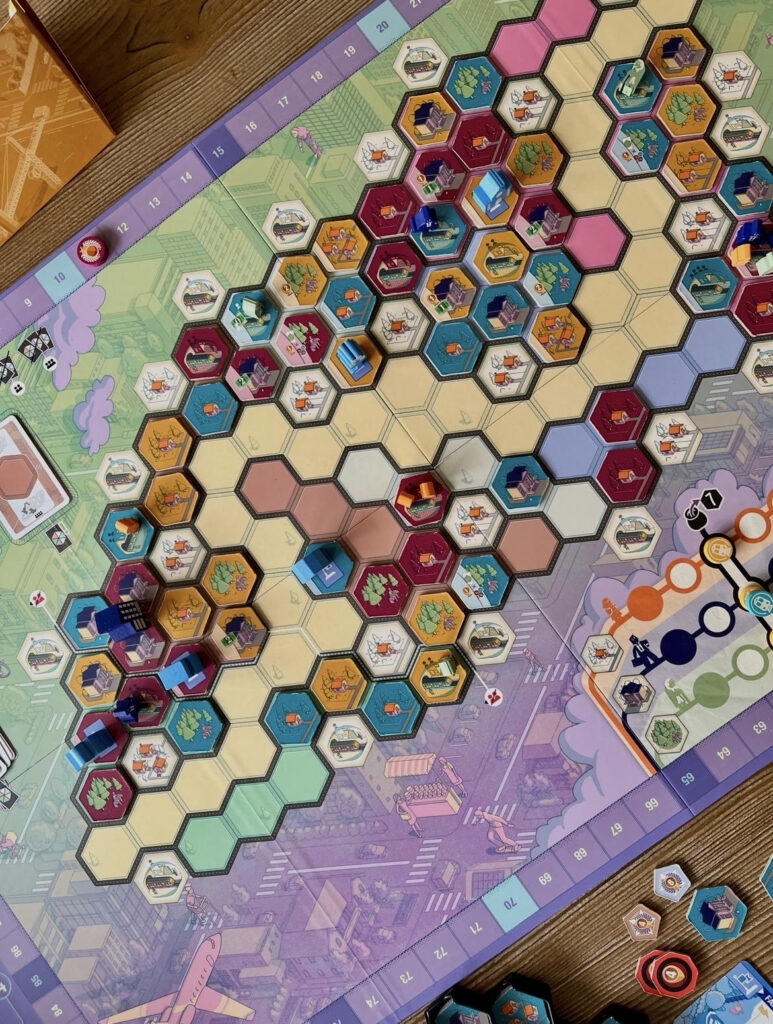
It’s all fairly easy to understand, and I like that the buildings actually make sense together. A house might help you win a neighborhood majority, give somebody else’s park more points, or contribute to a connected group of buildings that earns income. Putting a tile down usually does more than one thing, and sometimes the person who benefits most from your brilliant planning is another player. Very generous of you.
I also like the way income is handled. At the end of each round, you earn either money or points based on your largest connected group of buildings reaching into the active zone. This means you can’t just pay attention to whatever little patch of town you’re currently developing. You want your buildings to connect across the city, and if you can make those connections while getting in someone else’s way, so much the better.
Between rounds, you also bid for turn order and add new tiles to your bag. These can be upgraded versions of your basic buildings, and the bidding is a BIG deal because earlier players get first pick of those upgrades, with the first player getting an extra one.
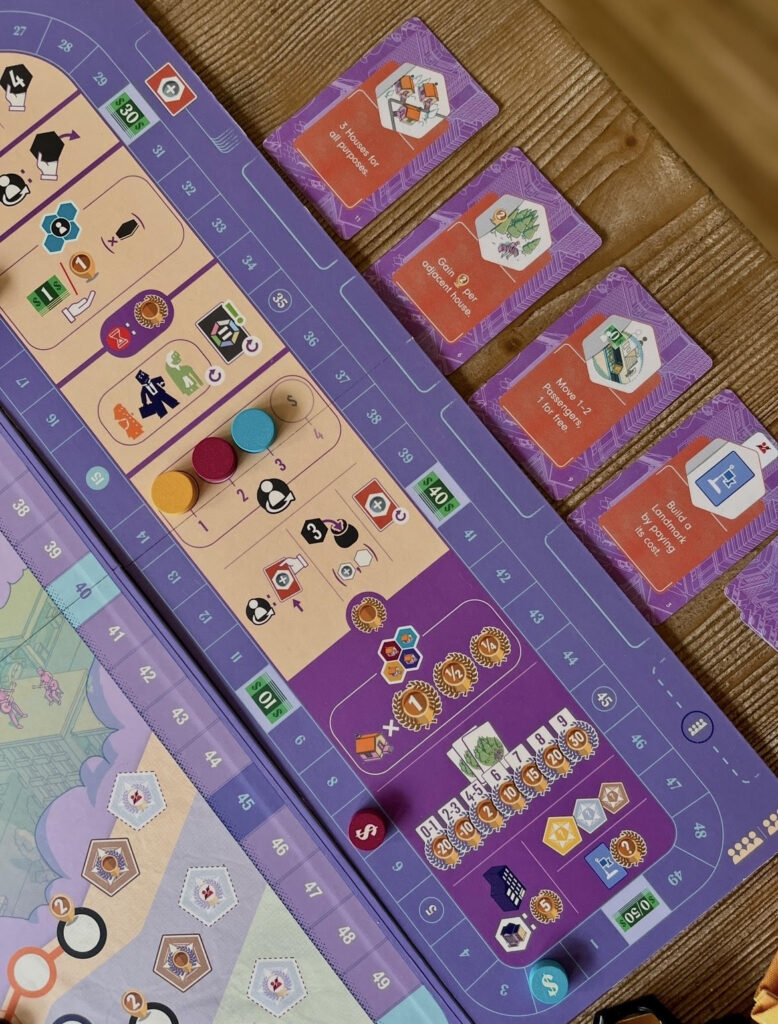
Everyone adds the same number of tiles to their bag each round, so whatever you don’t acquire in advanced tiles, you’re making up with basic ones. This gives you quite a bit to think about when choosing between money and points during income. Do I take the points now? Save up for a better bid? How badly do I want that particular upgrade? I like having to weigh those things, especially knowing that spending a pile of money to go first might leave me short of cash for something else.
A reservation I have with this is that we found the consequence of losing bids made the game feel less exciting. You have some control over your draws, pulling six tiles (or eventually seven) and choosing four, but there were still turns where I was staring at my options and thinking, well, I guess I’ll put a bank here.
And there is something to think about when placing that bank. But even the upgraded buildings tend to make your existing actions more profitable rather than give you something new to play around with. I might earn more money or score a few extra points, but I’m largely approaching my turns the same way. They’re useful improvements, and there’s certainly skill in building your bag well, but I would have liked a little more variety in what those improvements let me do.
The landmarks, however, are another story entirely. These are easily my favorite part of Downtown.
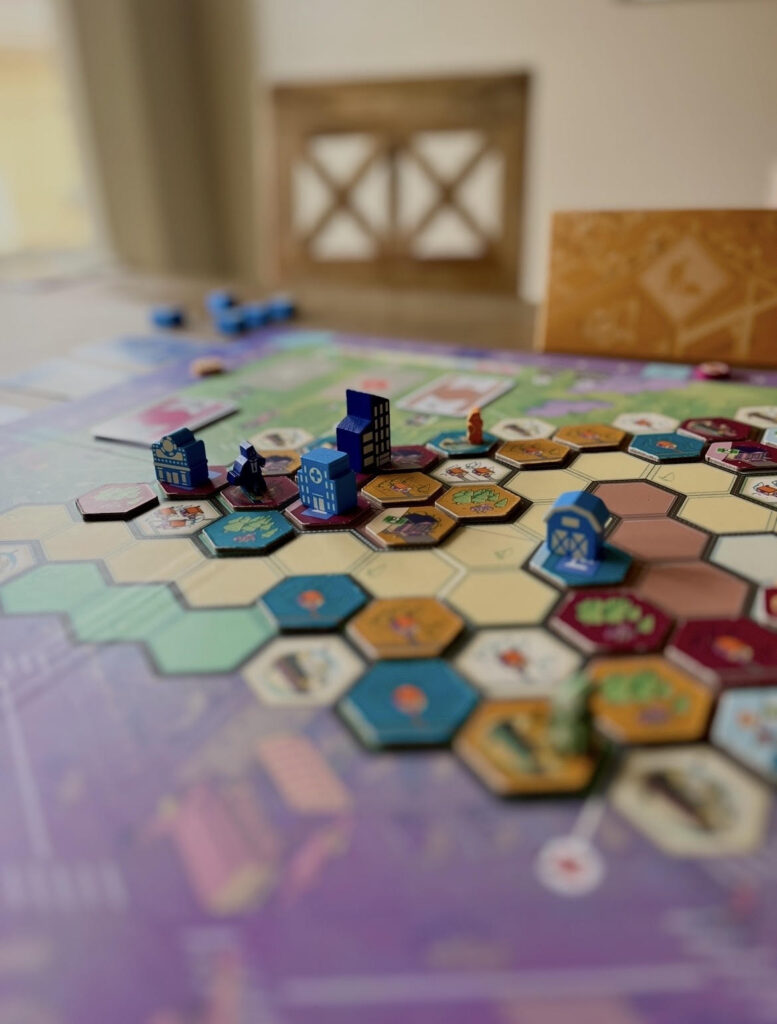
They’re special buildings with abilities that can make a bit of town suddenly very interesting. The Clocktower scores when buildings are placed along its line of sight. The Market benefits from surrounding banks. The Hospital strengthens your connected cluster for income. There are a bunch of these, and they’re great fun to play around with.
I love how a landmark can completely change what I’m looking for on the board. A spot I had no interest in a moment ago suddenly looks like prime real estate. Maybe someone else has already built half of what I need, and now I can come along and take advantage of their hard work. Thank you very much.
I think it’s where the game shines. You start seeing possibilities in the city that weren’t there a turn ago, or at least possibilities you hadn’t thought to look for. And when a landmark works well with the buildings around it, it’s a great feeling.
We actually found ourselves wishing we could play more of them. You’re limited to two landmark tiles, assuming you acquire them and actually draw them, and that felt a little stingy. Maybe allowing more would throw the whole game out of balance. I don’t know, and I’m definitely not volunteering to do the math. But our desire for more landmarks did make me wonder whether the rest of the buildings were doing enough to keep us drawn in. The potential for interesting combinations is definitely there, and I wanted to spend a little more time exploring them.
I had a similarly good time with the subway system. Moving passengers might actually be my favorite individual action in the game. You’re figuring out where to put a station, how much you can afford to spend moving people there, and whether you can get them near the buildings they want to visit.
The rewards for moving those passengers are a little less exciting than the process itself. You’ll advance along three different tracks, depending on which passengers you move, and eventually you can earn the ability to draw seven tiles instead of six from your bag. You still only keep four. I understand why that’s useful, obviously, but in practice the extra choice didn’t make an enormous difference for me. Otherwise, you’re just earning points for reaching certain thresholds and competing for endgame point bonuses.
The rewards are all perfectly good things to have, but the real fun for me was figuring out how to move those little people around town. Which is actually maybe a very noble attitude for a city planner to have, now that I think about it…
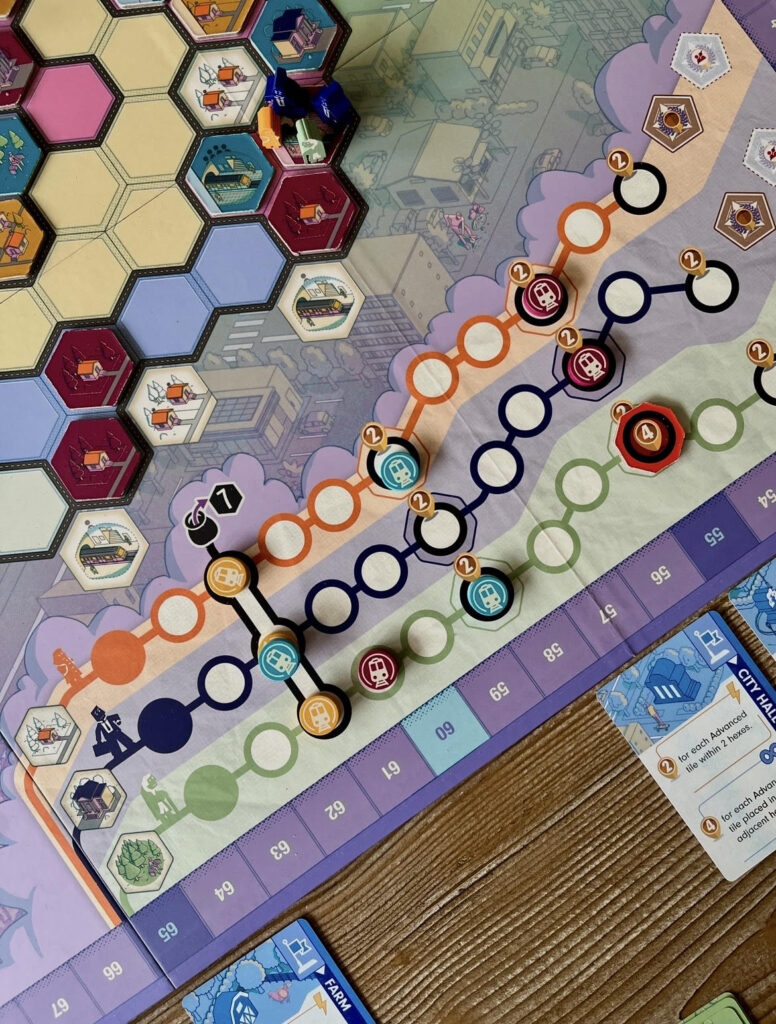
It looks absolutely beautiful though. Ian O’Toole did the artwork, which is always good news as far as I’m concerned, and together with Anca Gavril’s graphic design, they’ve made the game surprisingly easy to read. There’s a decent amount going on across this board, but I can generally look at it and understand what I’m trying to accomplish without much trouble.
So where does that leave me?
Despite my reservations, I actually think this is a good entry point into Hovakimyan’s games. It’s slightly gentler and I think it’s most enjoyable at three and four players. Something I admire about Hovakimyan’s designs is how much he gets out of players competing and interfering with one another, and that’s exactly my kind of game. There’s plenty of that here, and I think it’ll appeal to people who like thoughtful tile placement games where your decisions are constantly influenced by what everyone else is doing.
What keeps Downtown from being a game I really love is that its more typical turns don’t always have the same appeal as its best ones. There’s a special bit of magic when a handful of rules and choices start producing moments nobody could have planned for, and I got some nice glimpses of that here, particularly with the landmarks. I just wish those moments came around a little more often. There are some aspects to the game that maybe have a little too much restraint.
Still, there’s a lot to enjoy, and I’d happily spend another afternoon building a city with a few fellow planners. Then again, I’ve only read one enormous book about urban planning. Maybe I need another 1200 pages before I’m qualified to say.
Downtown will be on Kickstarter Tuesday Nov 17th!
Thank you to Bitewing Games for the prototype copy.