
I have always loved astronomy. I love reading about black holes, planets, rockets…all of it. My dad taught me to recognize a whole host of constellations on backpacking trips growing up. The problem for me is that astronomy eventually wants you to do math.
And while I know other useful things like who George Washington is (we covered the Civil War a little bit in college!) I have never been particularly confident that I could distinguish a useful physics equation from a recipe. I’m not sure if that says more about my math or cooking ability.
So maybe it was inevitable that I would enjoy Payload, a game about running a space company, where I can build rockets without the game needing me to actually understand rocket science.
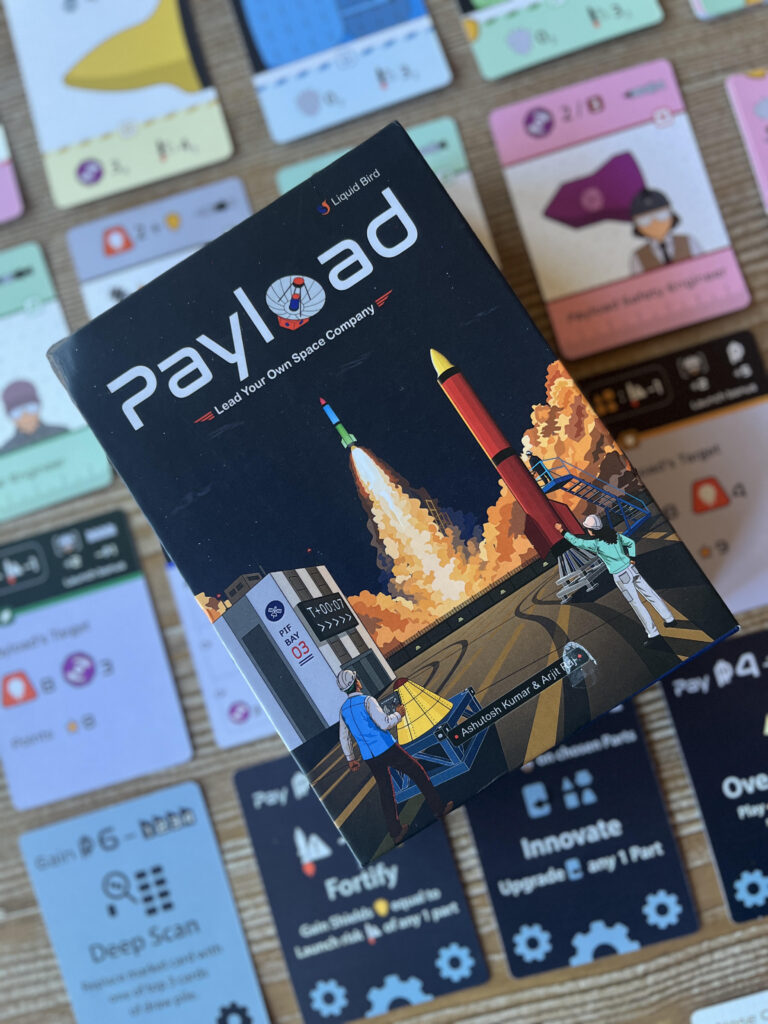
In Payload, you’re buying rocket parts, hiring Engineers, bidding on Payload contracts, managing your money and Shields, and eventually trying to convince imaginary astronauts (they’re not actually in the game, just my head canon) that the rocket you’ve cobbled together is ready to leave the planet. And I really enjoyed the process of building all that up.
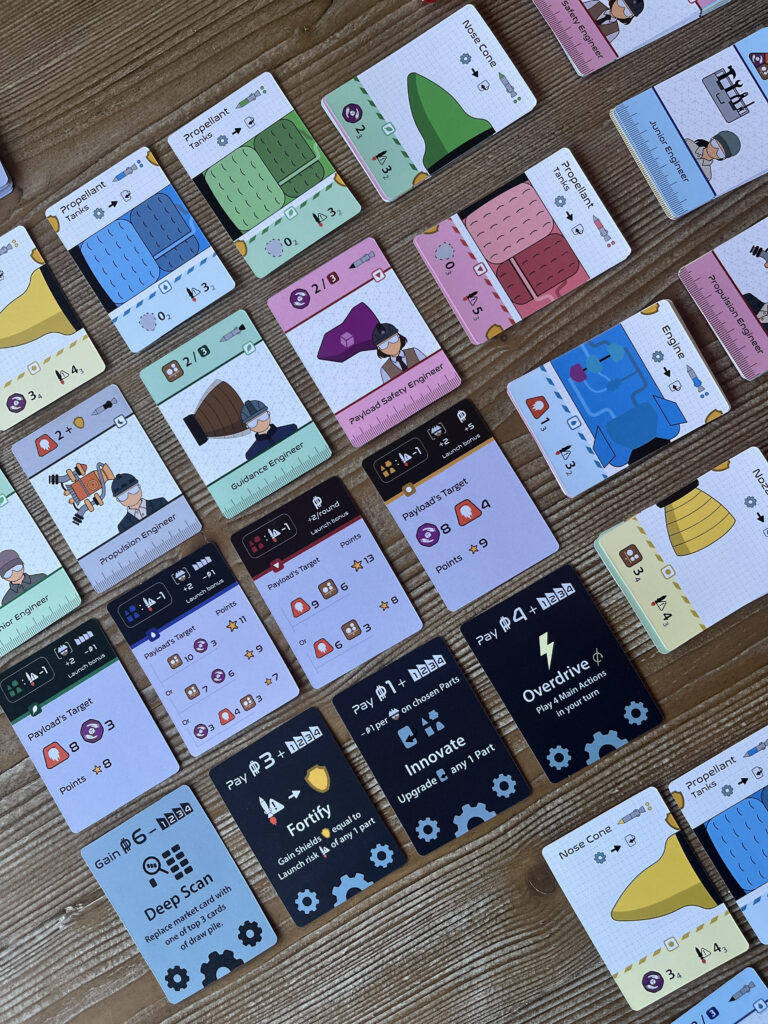
It’s great watching the rocket take shape as you piece together a Nose Cone, Propellant Tanks, Engine, and Nozzle, all while hiring Engineers to improve its capabilities. You’re always balancing what you need against what you can afford, while the Parts and Engineers markets keep shifting underneath you.
Then there are the Payload contracts, which give the game some direction. You need to build a rocket that can actually meet their requirements, while matching colors can reduce your Launch Risk. But in order to get the Payload contracts, you need to bid on them. If you read my reviews, you know I love a good bidding game.
We played this several times at two players, and the bidding mechanic at that count is just okay. I actually think the bidding system itself is pretty clever; it’s just not terribly exciting with two, especially when the other player can’t really bid, which definitely happened. Two-player bidding is tough to get right, and, in my opinion, the best games to pull it off are Martin Wallace’s Tinner’s Trail and Reiner Knizia’s Ego.
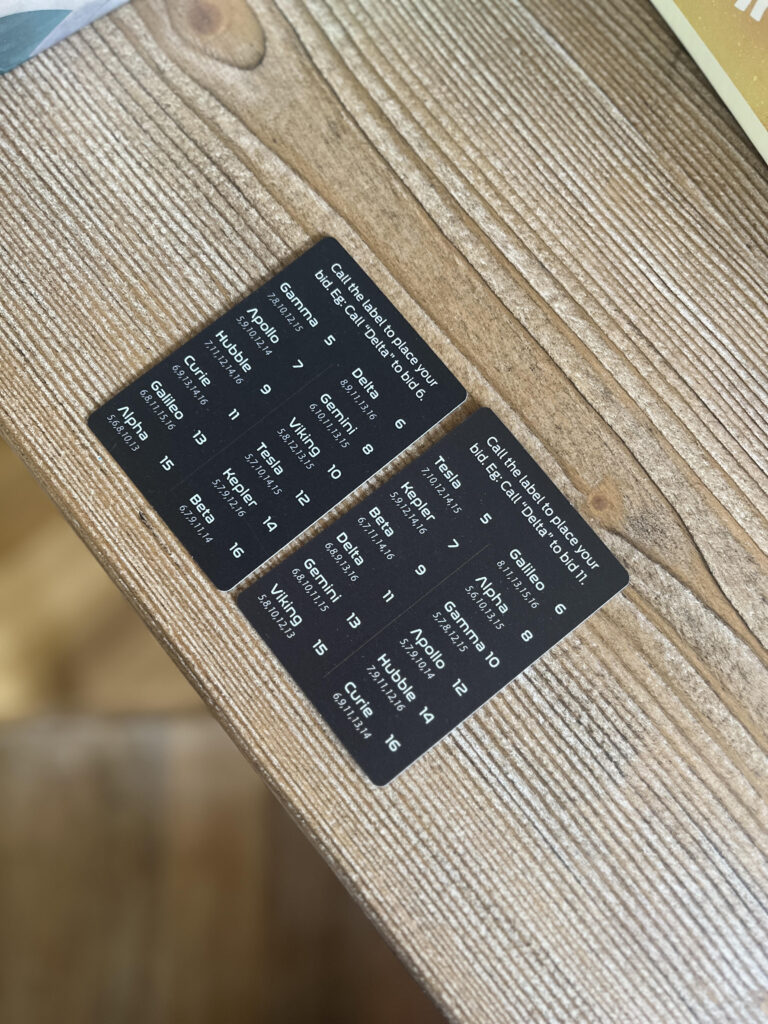
The way it works is through bid cards. Each card has different “labels” paired with numbers, so you might announce “Gamma,” while the other players can only see the possible values Gamma could refer to on their own cards… maybe 7, 8, 10, 12, or 15. Everyone states a label in turn order, then the actual values are revealed. The lowest bid wins, and the winner takes the Payload and receives money equal to their bid minus the Payload’s market cost. It creates a nice bit of uncertainty, and I can definitely see myself enjoying it quite a bit more at higher player counts, though I haven’t tested it there.
Eventually you have to do the scariest thing of all: launch it. You pay your money, roll the dice, look at the Weather Die and you wait to discover whether your blood, sweat, and tears is a genius triumph of human ingenuity or… a big fat pile of rubble.
Launching rockets is ultimately what you’re working toward (the game ends after someone launches three rockets, or once every player has launched two) but there’s quite a bit going on around that goal. You’re continuously making decisions about risk, money, engineers, bidding, upgrades, Payload contracts, and timing. Sometimes the safest choice is to wait, but waiting might also mean someone else grabs the Payload contract you want.
There’s some nice tension throughout the game, and I like the mix of mechanics. The prototype card quality is also surprisingly nice, actually. Pretty similar to Chip Theory’s PVC cards. The game also moves along pretty well, with our games clocking in around an hour.
One thing I did not love was the way money is tracked. You stack two cards on top of one another to show your total, and those cards inevitably get bumped. More than once we ended up wondering exactly how much money someone had before the accounting system got nudged.
Overall, I think Payload is a solid game with plenty of interesting decisions, though I’m not sure any of its individual ideas do quite enough to distinguish it from the many good games competing for our attention these days. That’s perhaps a slightly unfair criticism, because there really isn’t anything here that I particularly dislike. But it’s also the unfortunate reality of a hobby with so many good games being released that even a well-designed one can have a hard time standing out.
Regardless, I did enjoy the process of building rockets, taking calculated risks, and watching everything come together. The light educational value is probably what gives Payload its own little niche, and I think it’ll be an especially good fit for space enthusiasts, particularly those of us who love the subject but have absolutely no business doing the mathematics that actually gets us there.
Thank you to the designers for a preview copy. Payload will be coming to Kickstarter soon.