
Level 99 Games has this delightful habit of making old games feel like new discoveries, and Pixel Tactics is the latest one to take over my table.
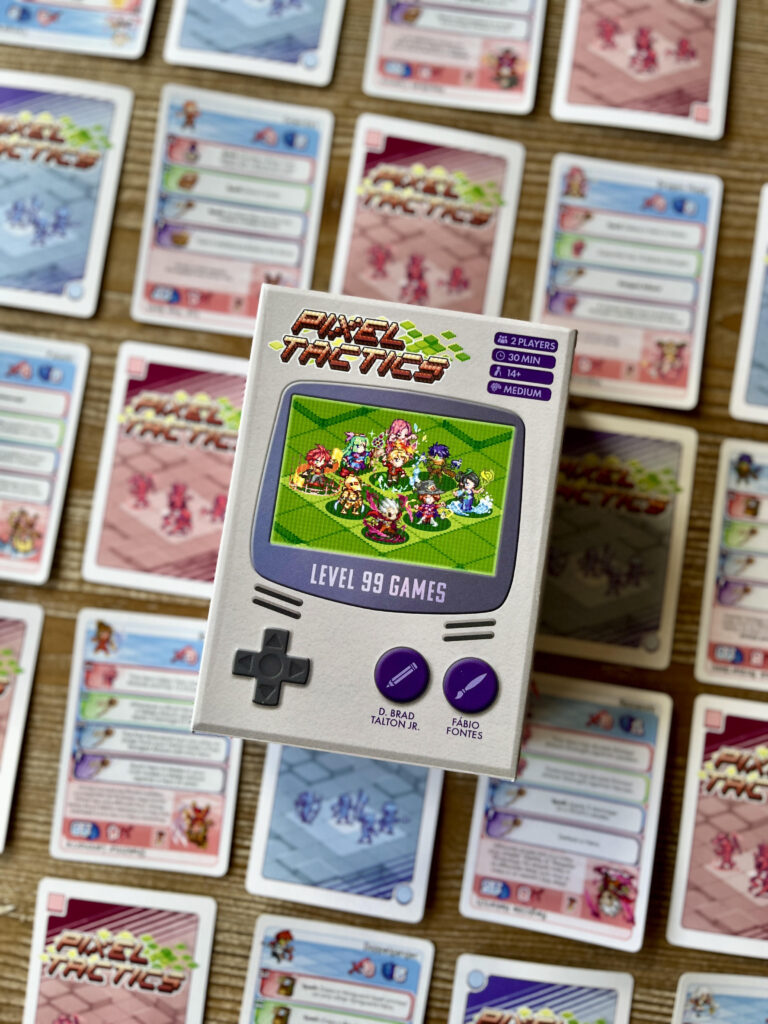
Outside of Bullet (my favorite bullet-hell fever dream of all time), Pixel Tactics is my current obsession. I’ve been playing the original set, updated with retro 16-bit art, where both players get identical decks of 25 cards featuring tiny pixelated heroes and leaders. It’s a two-player grid battler. Choose one Leader for the game, summon units into a 3×3 grid, use attacks, and aim for the other guy’s Leader’s jugular. Simple enough.
But the details make it juicy. Every card has four different abilities depending on where you place it: frontline fighter, side hustle, backline defender, or a powerful one-time “Order” effect you toss out like a grenade.

The real miracle is how much game is stuffed in here. Picking a Leader allows for a million different plans, and with 25 to choose from (plus expansions), there’s no shortage of ways to let it fly. There’s Demitras Denigrande, who heals any hero who makes an attack. There’s Lixis Ran Kanda, who applies 1 damage to each Rival Hero and Leader at the end of each turn. Or even Seth Cremmul, who forces your opponent to play with their hand revealed. Each Leader feels gamebreaking, and I love a game that still functions while feeling wild.
This is not a grand strategy game where you can meticulously plan five turns ahead. Your leader stays planted in place, a steadfast presence while the real game happens in your flexibility to use what fate deals you. Pixel Tactics truly is a tactical, moment-to-moment game. You’re meant to navigate the storm with whatever battered ship you happen to captain today. Adaptability is mandatory here. If you can’t pivot, you perish.

Some Leaders feel overpowered and certain matchups seem to stand no chance. But like most chaotic systems, the balance emerges not in perfection, but in resilience. Sure, you’ll have the occasional brutal matchup, but overall, the swings and excesses even out. I find this to be quite similar to Bullet in that regard.
The balance here isn’t about every game being fair. It’s about giving players enough tools and choices to work their way out of tough situations. The game encourages you to play the best of 3 or 5 rounds. Victory favors those who can wield wild power with a steady hand and accept when fortune deals you a rougher hand.
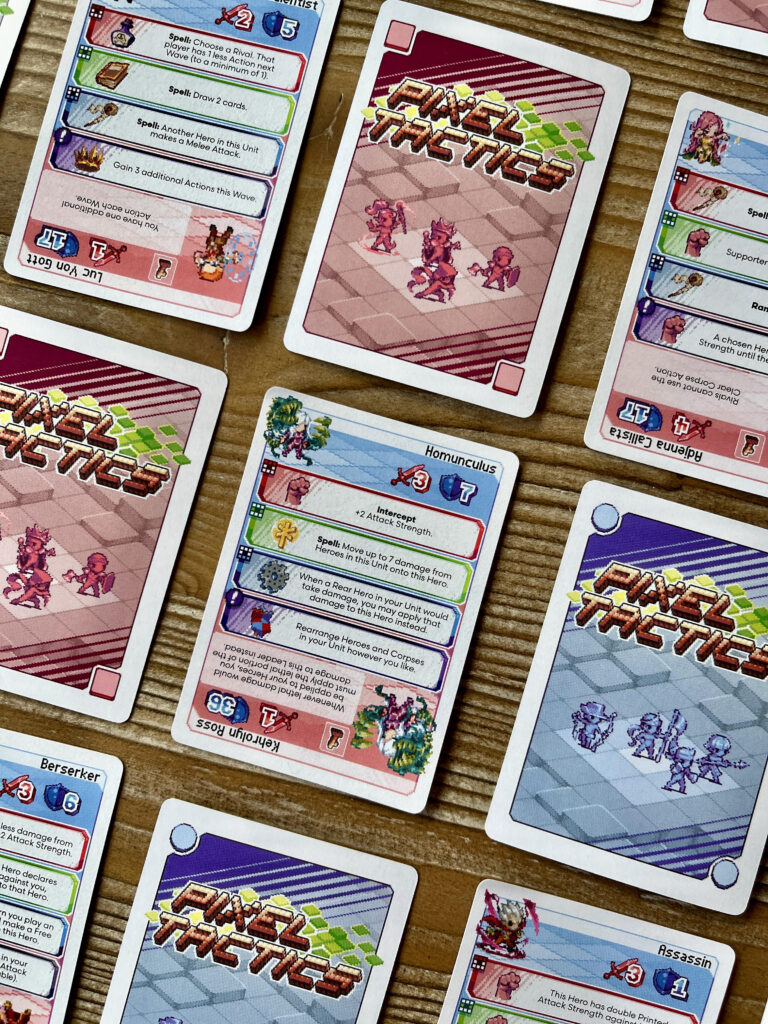
The game is straightforward and fast to learn, but the text density (and text size) can cause moments of AP as you weigh your options. Decisions do matter, which means Pixel Tactics rewards players who enjoy chewing over possibilities rather than sprinting through the game on instinct alone. Although, you CAN do that and it’s still fun! But for this reason, I think this game will appeal to gamers with some experience.
The 16-bit artwork is charming and full of nostalgia. It’s a loose, playful theme that fits the feeling of the game perfectly. This is a battle that’s part tactical precision and part improvisation. It doesn’t pretend to be anything grandiose; it just leans hard into being a love letter to scrappy, pixelated brawls.
Pixel Tactics is for players who enjoy problem-solving in real time and who don’t mind plans getting destroyed by a single card. If you crave replayability, it will keep your brain buzzing for a long time. It’s a game for people who grew up blowing into cartridges, making do with what you had, and figuring things out one pixel at a time. And really, what’s more 16-bit than that?
Thank you to Level 99 for kindly providing a review copy of Pixel Tactics. Super Pixel Tactics is currently funding on Gamefound.