
What I absolutely love about David Thompson and Trevor Benjamin’s games is how straightforward they tend to be. You aren’t moving up eight different tracks while trying to remember how seventeen interlocking systems affect the price of wheat or something, turning your board game into a veritable Rorschach test. Instead, they give you a relatively simple idea and allow you to explore it deeply.
Rebels Against Rebellion is a card-driven war game set in Scott County, Tennessee, during the American Civil War. Tennessee was deeply divided over secession, particularly in the eastern part of the state, where Unionist sympathies remained strong. Scott County voted against secession by an overwhelming 521 to 19 and eventually passed a resolution declaring itself the “Free and Independent State of Scott.”
It’s one of those historical moments that sounds almost a bit Hollywood-romantic until you remember what it actually meant for people: neighbors being forced to choose sides, local militias forming in secret, farms raided, property destroyed, and ordinary people trying to defend their homes while this enormous national conflict closed in around them.
I think one of the biggest dangers in learning history from a distance is that everyone eventually becomes a symbol. The loyalist, the secessionist, the soldier, the outlaw. They begin to just look like pieces placed on opposite sides of a map. But we don’t live as symbols. We live as fathers, neighbors, and friends, making a lot of decisions without knowing what those decisions will cost.
Civil conflict is especially terrible because it’s not just armies who become divided. It divides things that were meant to remain joined. The battlefield enters the home, and bigger questions begin asking personal loyalties to tear themselves apart.
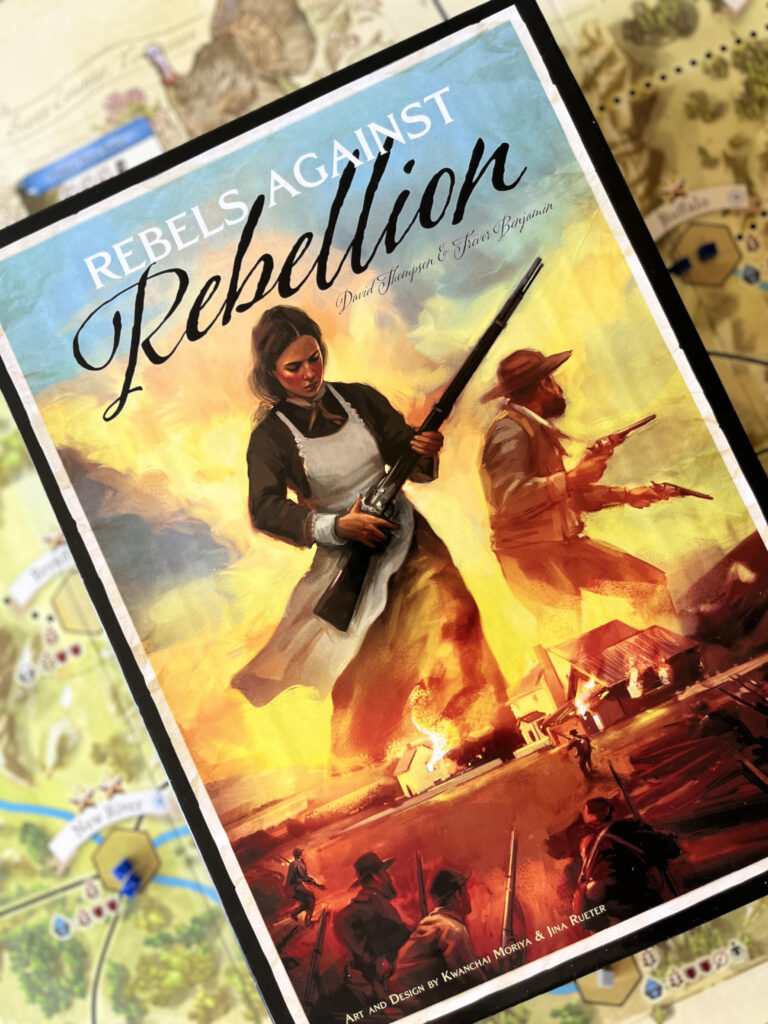
The cover is what initially drew me to the game (of course it did, Allie). But bear with me. It has an almost bucolic quality to it (I’ve been trying to slip that word into a review for a while), though actually playing the game does not exactly make you feel like Laura Ingalls Wilder defending the homestead. Much less churning butter…
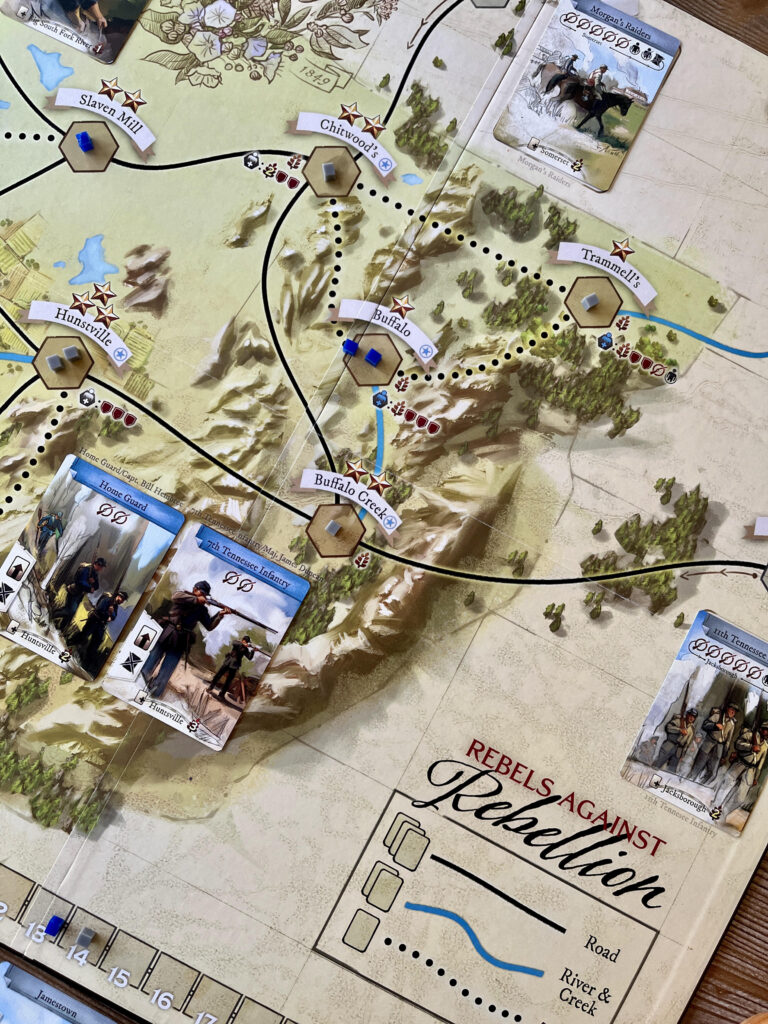
The game is all about spreading your control across Scott County. The cards in your deck represent both the units and locations you control, and you use them to move, attack, recruit, and strengthen your deck.
The interesting twist is that taking control of a location also means adding that location’s card to your deck. Some of those cards are useful. Others are much less exciting and will begin clogging everything up.
This is where a lot of the struggle in the game resides. I want to reach a certain location because it offers a powerful card, but getting there might require me to take control of two far less helpful locations first. How much inconvenience am I willing to place in my deck for the sake of what lies beyond it? You can see how this works pretty well thematically too. What burdens can you accept for further help?
And even getting rid of cards isn’t as simple as happily trimming away the garbage. Your cards represent actual control on the map, so losing one means something is given up there too. The deck and the board are constantly tugging on each other.
Some of the game’s simplicity also comes from the fact that food is your only real resource. You’re spending it primarily to upgrade cards and take control of locations, but food is also the game timer. Every food token you spend is permanently removed from the game. There are 50 tokens, with the final ten being a different color. Once you reach those last ten, the game can end at any time if someone starts their turn with more points than their opponent.
Allow me to beat one of my favorite drums here for a minute: freedom isn’t simply being able to go wherever you want and take whatever you can get. Choices come with consequences. If you claim something, you may also become responsible for it.
That makes a lot of sense in a game about local resistance on a home front. Taking control of a location is good, obviously, but it’s not just good. That location now lives in your deck whether it helps you or not. The board changes your deck, and then your deck changes what you’re capable of doing on the board.
So the game becomes much more about knowing when to spread out rather than simply doing it as fast as possible. Is that great location worth taking on two useless cards to reach it? Do I push forward now? Do I spend some time improving what I already have? My opponent is moving toward the thing I want, so naturally every thought in my head starts screaming GRAB IT FIRST… but grabbing it first might actually make my position worse.
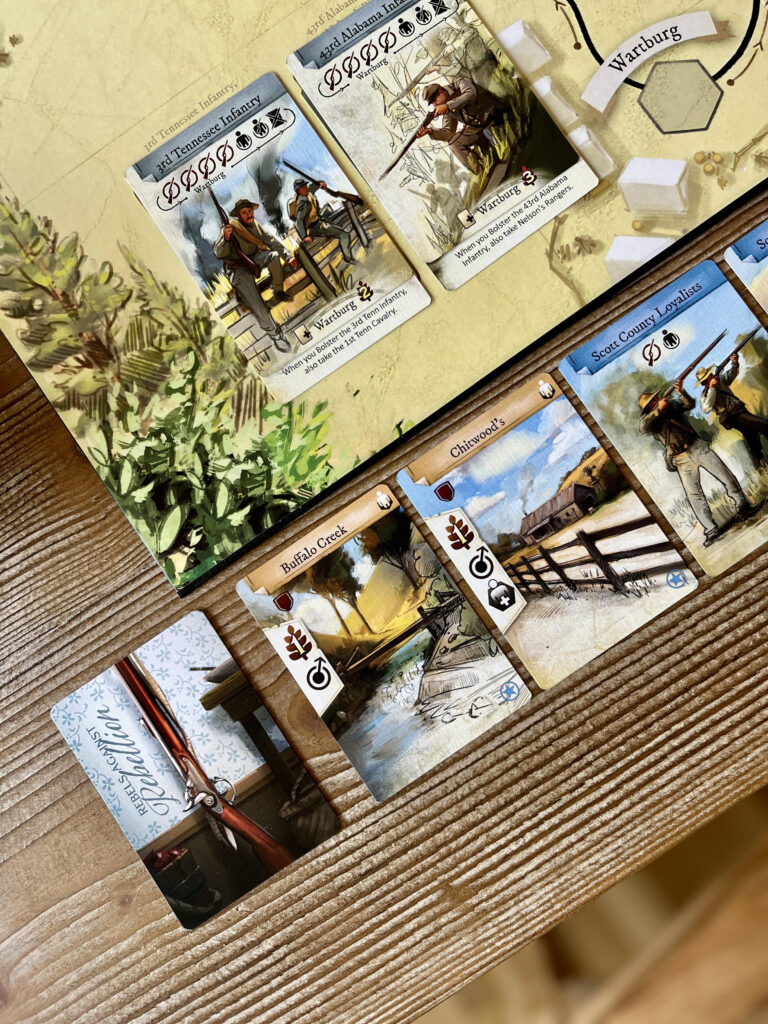
That push and pull is probably my favorite thing happening mechanically. Progress isn’t automatically improvement. More territory doesn’t always mean a better position.
The Loyalists and Confederates also feel different to play, which gives the game more life. You can definitely feel some Undaunted DNA here. It’s similar enough that if you enjoy that series, I think you’ll find plenty to like, but different enough that it doesn’t feel like I’m just playing another Undaunted game.
The subject matter itself helps freshen things up too. I love when designers pluck some little moment of history out from under the enormous shadow of, say, THE CIVIL WAR and say, no, look specifically at what happened here.
Because “the Civil War” is enormous. Almost too enormous to really get your head around. But Scott County is a place. These are individual communities and individual people making choices inside that much larger story. Big historical events are ultimately thousands upon thousands of little human stories happening at once.
The two-player game is incredible. It’s tense, interactive, and constantly gives you decisions to make without burying them beneath unnecessary complication. Our games have taken around 60–90 minutes, although the box says 45–60, which is probably accurate for people who don’t sit there for a month mentally reviewing every possible option before finally playing one card.
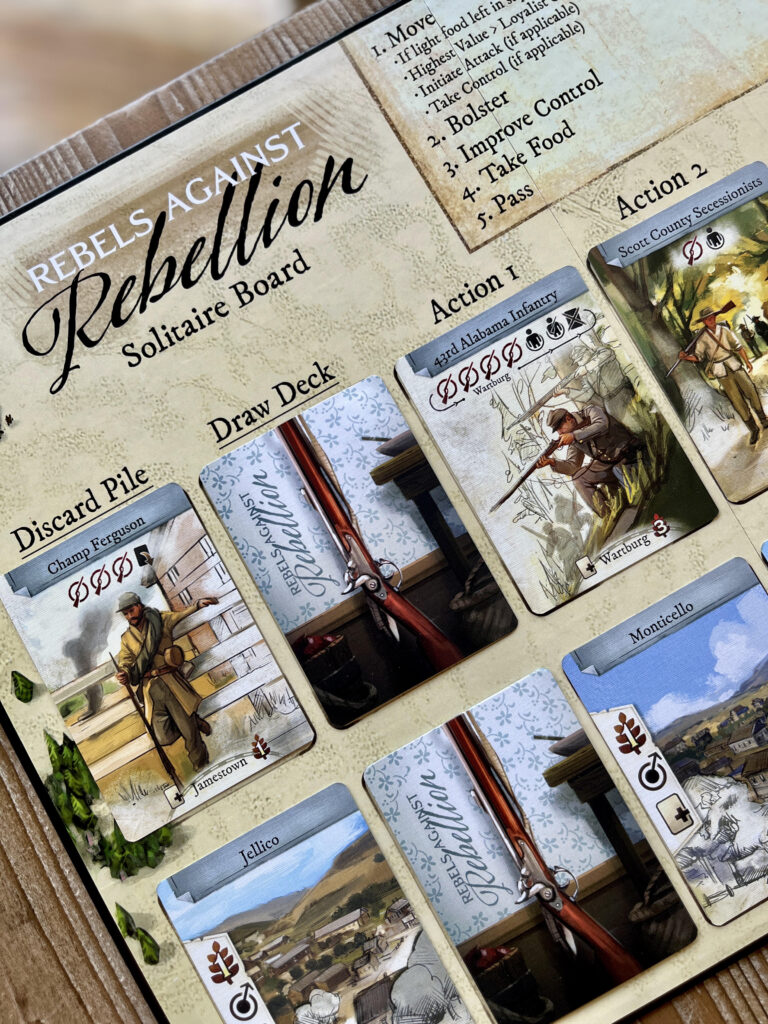
The solo game, meanwhile, is TOUGH. I’ve played three times and have yet to win. Solo, you play as the Loyalists while the bot controls the Confederate forces. It uses a priority system to determine its actions and is very simple to learn and run, which is vital for me in a solo game. I’m not usually looking to hold a part-time administrative job managing the AI.
It might sound strange to describe a war game as fun, particularly one built around a real conflict that divided communities and turned neighbors against one another. “Compelling” is probably the safer word. And yet we’ve genuinely had fun playing it.
Actually, I almost hesitate to call it a war game because I know what that phrase immediately brings to mind for some people: tiny impossible-to-grab chits and a gigantic map in some century or other.
Yesss, I’m gently poking fun.
The point is, if you’re not normally a “war gamer,” I wouldn’t immediately turn away from this one. Thompson and Benjamin are particularly good at breathing humanity into the genre. You’re dealing with named historical people and recognizable places, with artwork that gives these people some personhood instead of reducing everything to anonymous military units. They don’t make light of history but just bring it a touch closer.
And maybe that’s why their games continually work so well for me. History is obviously made up of movements and borders and armies, but underneath all of those things are ordinary people trying to figure out what they owe to their country, their community, their neighbor, their family, and ultimately their own conscience.
Rebels Against Rebellion gets a little of that into the actual deckbuilding. It’s not just that every advance has a cost. You actually choose whether the advance is worth it, put that cost directly into your own deck, and then keep drawing it for the rest of the game.
Thank you to Flying Pig Games for the preview copy.