
*I will only be discussing World 1 (out of 7) in this preview to preserve the excitement of discovery for you*
When trying to teach or explain Baba Is You to someone, prepare yourself to watch their eyes cross in confusion and a desperate attempt to hang on to the odd way you use words.
It starts normally enough: “The words on the board are the rules.”
This is usually accepted. “But the words are also objects,” you continue.
A slight hesitation.
“So you can push the word STOP away from WALL, which means walls no longer stop you. Or you can change WALL IS STOP into WALL IS YOU, at which point you become the walls.”
About now, they’ll ask you about any recent head injuries.
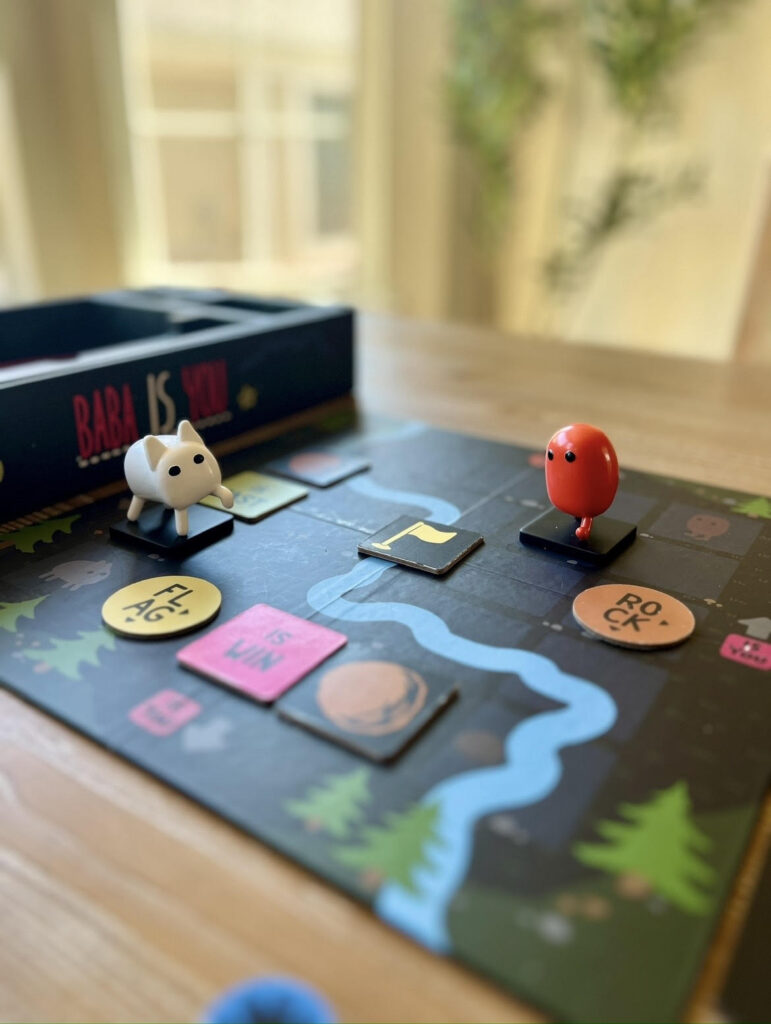
The trouble is Baba Is You uses extremely simple words to do extremely tricky things. It’s one of those too-rare high concepts that pushes its central idea amazingly far and executes it with confidence. It also introduced me to a new world of puzzle games, particularly Sokoban-like games (a grid on which you push objects around) and puzzles built around rule manipulation.
We have a funny habit of assuming that whatever is true right now is just the way things are. At twenty, you probably couldn’t have imagined that one day your friends would listen to Coldplay, shop at J.Crew—hell, that you would shop at J.Crew—and have opinions about the best way to load a dishwasher. Yet here we are. The world didn’t seem temporary back then. Your tastes, your habits, your friendships, your whole little arrangement of life felt permanent, mostly because you had no other arrangement to compare it to. You were bound by your context, limited by your day. The rules felt like facts.
That is also the basic idea of Baba Is You. When you first see WALL IS STOP, it feels like a fact about the universe rather than a temporary arrangement of words. Of course the wall stops you. It is a wall.
The game is all about recognizing that you are confusing the current rule with a universal truth. WALL does not have to be STOP any more than your twenty-year-old self had to foresee a passionate interest in arch support. It is simply what happens to be true at this particular moment. And, unlike most of life’s circumstances, you can walk over and push the words apart.
But Baba Is You isn’t interesting because nothing is fixed. It’s interesting because some things are fixed and some things only look fixed. You have to figure out which is which. One fool treats every wall as sacred. Another knocks them all down and then wonders why the roof came with them. Baba Is You puts you somewhere in the middle, testing which rules hold the whole thing together and which are waiting for someone imaginative enough to move them.
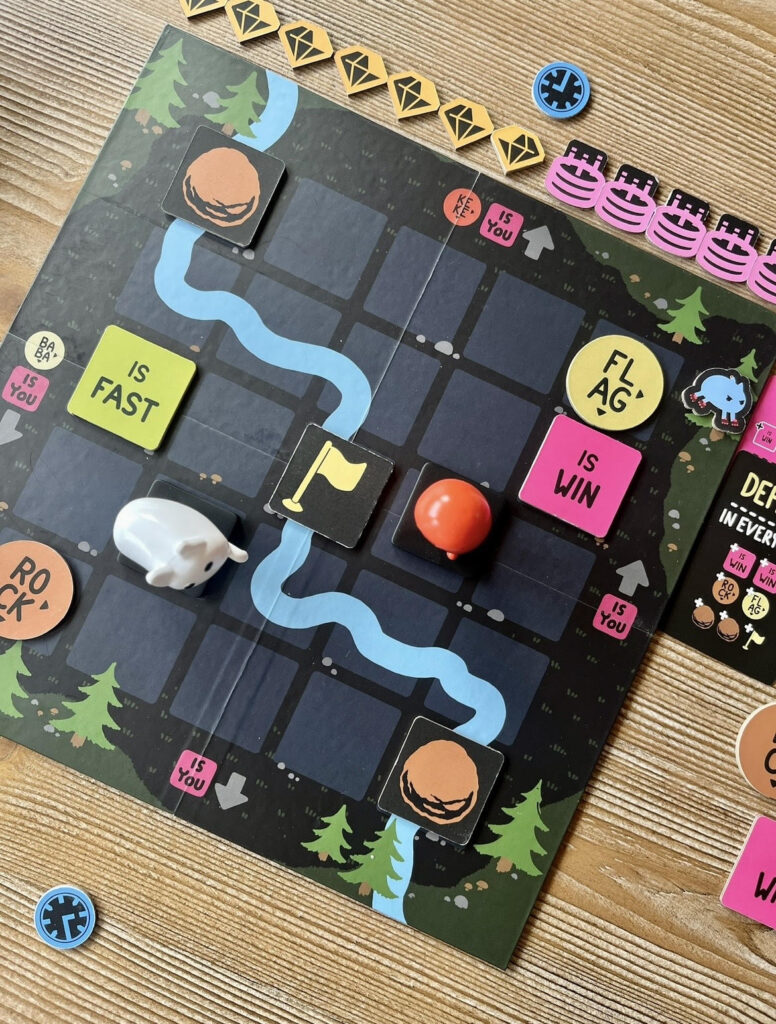
The video game, designed by Arvi Teikari (also a co-designer of the board game), is incredibly clever and incredibly difficult. It forces you to unlearn the normal way you solve problems, spending at least as much time undoing your assumptions as you do solving anything. My usual strategy is basically reverse engineering: figure out what the game seems to want, stare suspiciously at every word, and start tearing everything apart until something works.
The board game takes that same basic idea but drops it into an entirely different creative arena. Now instead of finding a way to win the level yourself, you’re trying to create a way to win the level before your opponent creates one for themselves…or, even more fun, uncreates yours.
Whatever rules you create are true for everything on the board, including the other player. That distinction is very important. You might be able to legislate reality, but unfortunately your political opponent also lives there.
Let me give you the quick nitty gritty so you have some context for the strange way I’m using words.
The game is divided into seven Worlds, each with five levels. Every level adds a new rule to play with while limiting your available vocabulary. Some basics remain (the noun tiles FLAG and ROCK, two IS WIN tiles, Baba, Keke, a flag, two rocks) but each level introduces a new rule plus one other rule already learned from that World.
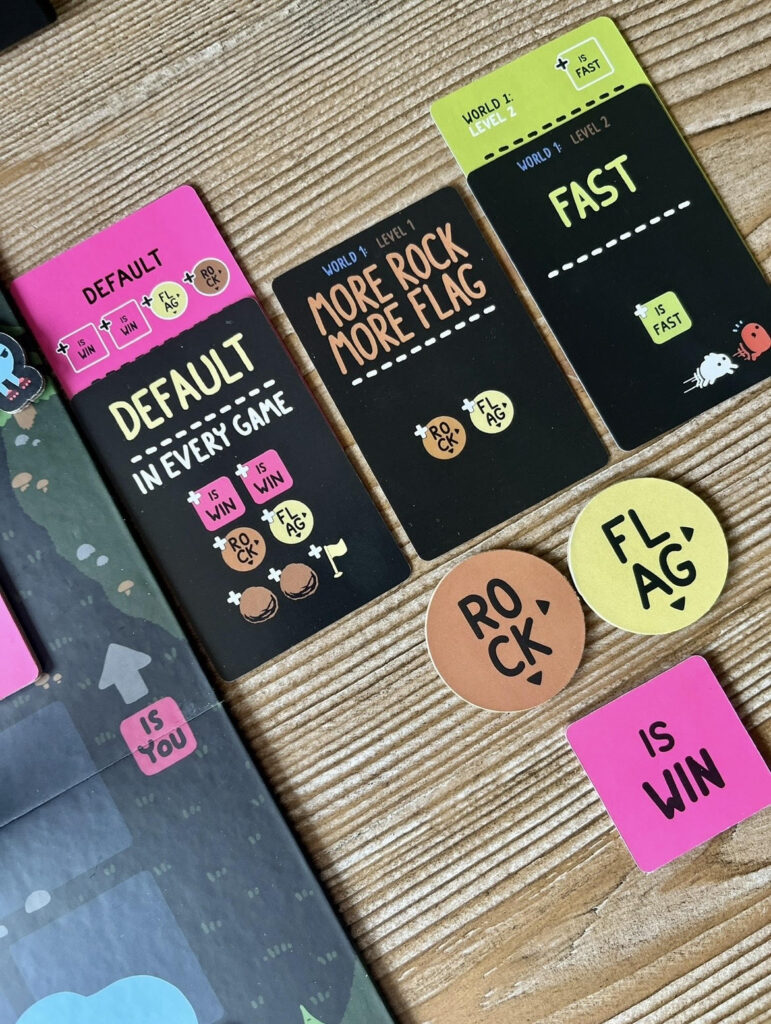
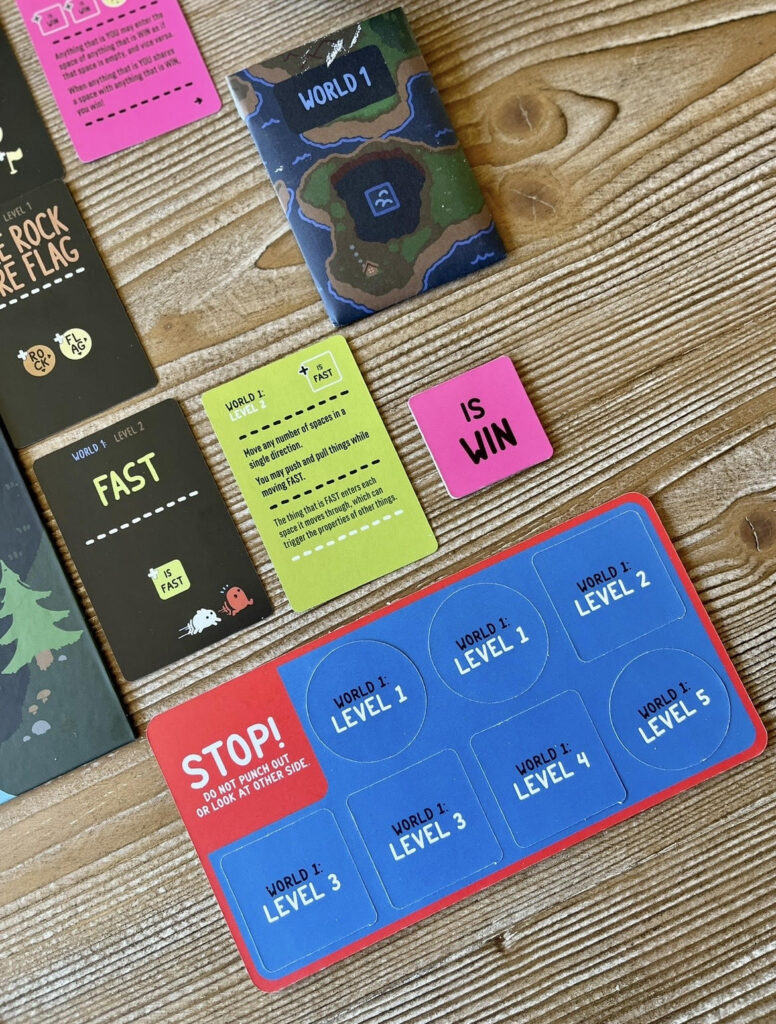
Maybe the level gives you IS FAST, allowing something to move any number of spaces in a straight line. On its own, that is not terribly exciting. The fun comes from asking the question: What can I make fast?
On your turn, you take two actions, choosing between Move and Place. Move lets you move something that is YOU, pushing things in your way and optionally pulling something behind you. Place lets you add a noun, property tile, or object beside something that is YOU.
Simple enough. Except those actions don’t mean much until you start messing with what the words mean.
Maybe you create FLAG IS WIN. Great. Except your opponent is closer to the flag. Less great.
But wait. There’s another rule in this round that lets you interact with the river running through the middle of the board. Can you somehow turn that into a problem for them? Can you move the victory condition? Change who YOU is? Can you make it impossible for either of you to win and force a “best two out of three” situation? That’s actually part of the game!
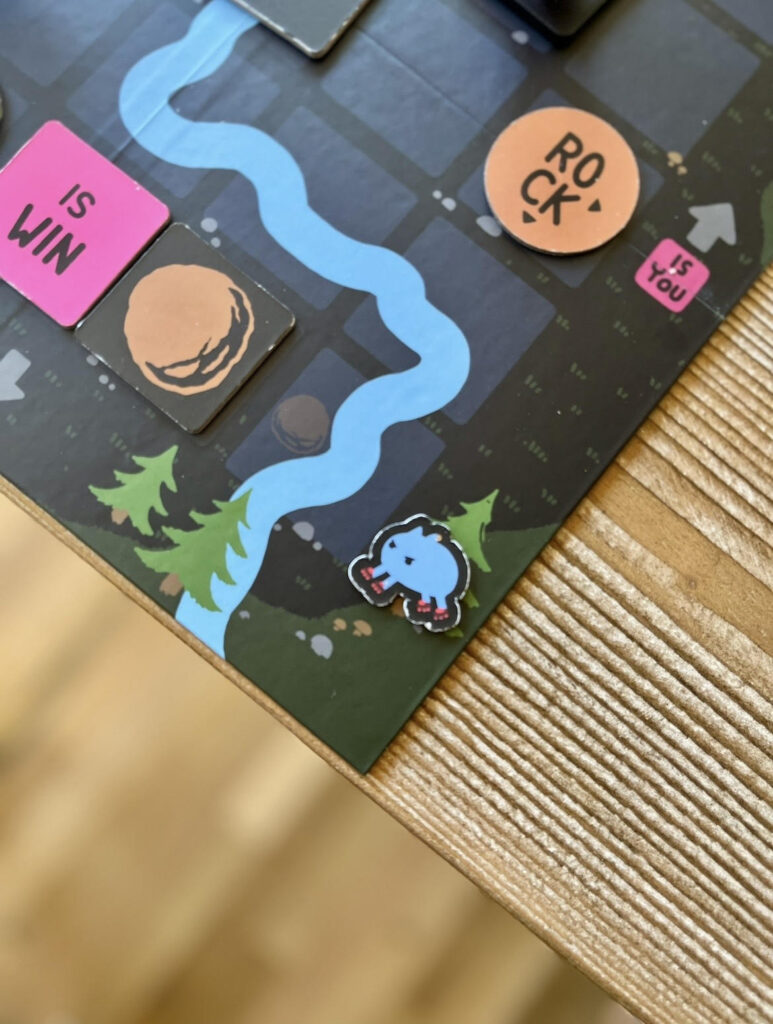
This is where Baba Is You stands out from every other game I’ve played. This is the new height of puzzle games for me.
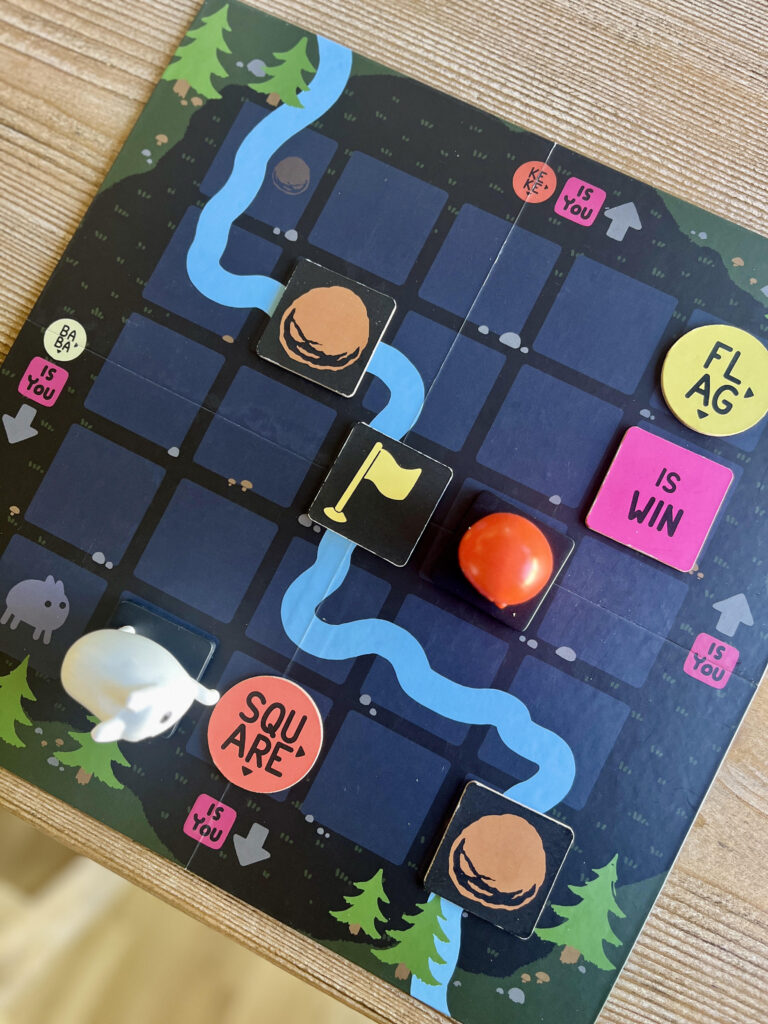
My favorite rule from World 1 is SQUARE. SQUARE refers to property tiles currently being used in an active rule (things like IS WIN) and if SQUARE IS YOU, you can move one of those property tiles.
If your eyes glazed over halfway through that sentence, don’t worry. It makes much more sense when the thing is physically sitting in front of you. That paragraph is for the nerds who demand the deets immediately.
Here’s why SQUARE is so fun. Suppose BABA IS YOU. Then you create SQUARE IS YOU. Now you can move property tiles that form active rules.
Your opponent has created FLAG IS WIN and is standing one space away from victory, already feeling very pleased with themselves. Not so fast.
You move IS WIN away.The flag is no longer WIN. Their carefully built reality has been repealed. That is basically the entire pleasure of Baba Is You: watching someone build a logical world and then walking over and changing one word.
I have mercifully illustrated this scenario for you below.
For a game built from extremely simple words defining extremely simple rules, it is surprisingly tricky to explain, which brings me to one of Bitewing’s triumphs here: the rulebook. My prototype version is only twelve little pages long, and it does an excellent job explaining the concepts and then moving aside so you can explore their consequences.
However, on top of that, I desperately needed gameplay examples before I understood what sorts of things I should actually be trying to do. At the time of playing the prototype, this didn’t exist and we were able to figure out the level rules for the most part but certainly struggled with a few levels. However, it sounds like Bitewing will be making this dramatically easier in the final version with a second rulebook whose sole function is to explain the rules for each level WITH examples!
This is a game for the creative soul, but perhaps specifically the creative soul who also has a little software engineer living somewhere in the frontal lobe. Maybe those are the same soul. I don’t know.
In a sense, you’re programming the game to beat your opponent while somebody across the table programs the exact same game for their benefit. You’re trying to write a law that helps you before they can change that. And this is probably why I like the board game a bit more than the video game.
In the video game, you manipulate the rules to solve an authored problem. You stare at the level, push words around, realize you’ve trapped yourself, restart, and stare some more. Occasionally (or for me, frequently) you can get completely stuck. This is absolutely fun and worth the effort of puzzling over it. But tricky to translate to a board game environment.
The board game has you manipulate the rules to try and stop another person. The problem keeps changing because someone else keeps messing with it. You don’t get stuck so much as just duke it out. It sort of changes Baba from a puzzle about rules into a fight over rules.
You’re continuously creating new problems for each other. I think I prefer that reactive, adversarial version to the more contemplative one because rule manipulation becomes a weapon.
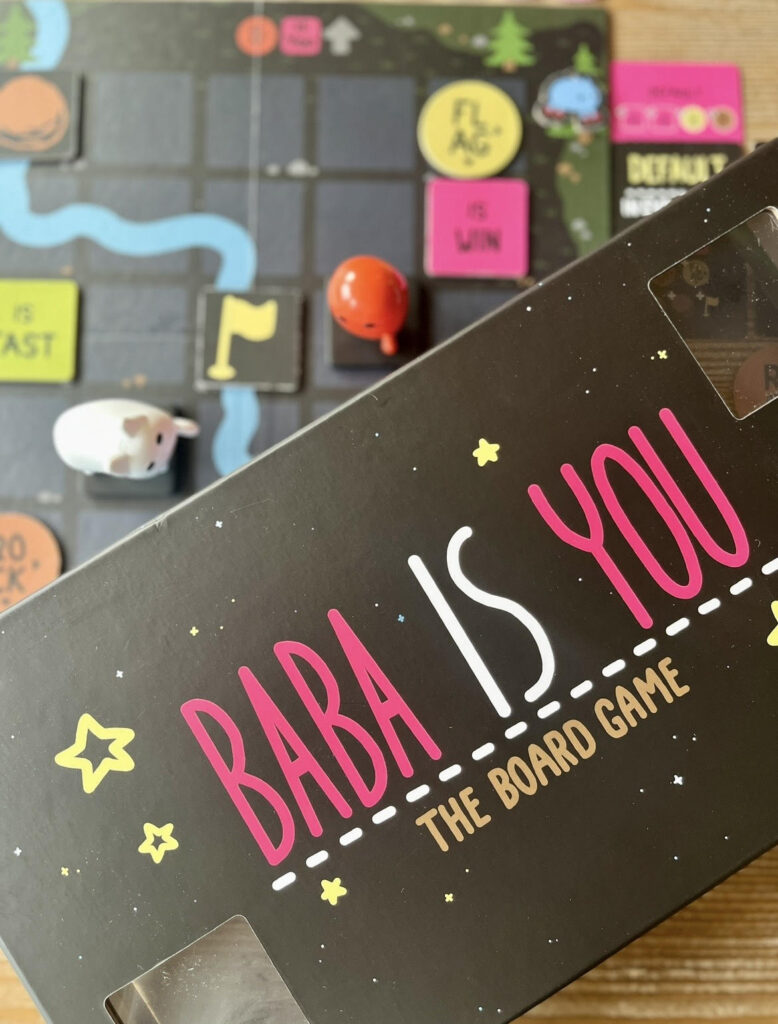
The game still demands a very specific style of thinking. Not because the rules are hard (they really aren’t) but because it wants you to have vision. The tools are sitting right there, and somehow you have to see not only what they do but what they could do if arranged differently. That’s a much weirder skill.
Once your brain starts working in the direction the game wants, that difficulty becomes a huge part of the appeal. It is unbelievably satisfying to discover a way to win because you have very literally outsmarted your opponent.
That said, there are some rules in there that we just flat-out couldn’t figure out how to use in an interesting way. In those cases, the games would usually just end very quickly. My guess is that with repeated plays and deliberately trying to make those rules work, more interesting strategies will start to emerge.
You also kind of need to be equally matched. If one person gets it and the other person is struggling, it’s probably not going to be very fun for them. This is a game that rewards sticking with it, though. You genuinely get better the more you play, even if the way it asks you to think feels unusual at first.
I should also say none of this feels like cleverness for cleverness’ sake. Designers Teikari and Peter Hayward use a tiny vocabulary, a tiny action set, and a tiny collection of components, and then wring an insane amount of possibility out of them.
We should all hope that whatever it took to achieve minimalist transcendence (radiation? Spider bite?) happens to us one day: that we harden, minimize, and look down to discover we have become a Game Design God who can design the essentials of an experience using only the most perfect and necessary mechanics.
And I’m not gushingly uncritical of everything Bitewing puts out, for the record. I didn’t particularly bond with either Orbit or Bebop, and I’ve said as much. But man oh man, these last few releases.
Chef’s kiss.
Baba Is You is absolutely one of the best two-player games I’ve ever played. It’s utterly brilliant and just so damn fun. It really feels like one thrilling moment after another, and the flexibility of the time commitment is a huge bonus. We can play a single level in ten minutes (sometimes less if I’m extra dumdum that day) or a full world in about an hour.
I’m not going to say this game is for everyone, cuz I bet it’s not. But this game is absolutely for me. It is difficult but not bloated and strange but not arbitrary. It makes you weaponize grammar, rewrite reality, and sometimes become a wall.
What more could one reasonably ask from a board game?
And now, in the spirit of the video game, I end with a poem:
Rules can be broken
Rocks can be YOU
I had a great plan
My opponent did too.
FLAG is no longer WIN
WALL has gone rogue
I think I’m a river
This game is DOPE.