
Vampire Lords is like some kind of dream birthday dinner of all my favorite foods. Instead of steak and mint chocolate chip ice cream, it has asymmetry, area control, and hearty deck building, with a splash of diplomacy for extra flavor. I can’t think of many games that successfully marry theme, game play and art direction as balanced as this, and pull it off with such confidence, especially for a debut design. Everything from the visual style to the mechanics feels like it’s part of one unified creative vision.
While playing this, I remembered that board games are an art form. While I personally play for enjoyment and judge games almost exclusively on their merits as entertainment, when I’m forced to confront this artwork thing, it feels like a revelation. Vampire Lords accomplishes so much of what I believe successful games should do. It’s a rare moment where fun and beauty occupy the same space without compromise.
It’s not emotionally moving in the way, say, a narrative historical game might be…it’s not trying to make you cry over your player board. But instead, it achieves a kind of excellence in its mythological exploration. It’s art not because it’s profound, but because it’s complete. Every piece fits and every detail resonates. I suppose it reminds me that games, when crafted with this level of cohesion and imagination, can be almost as expressive as film, just in their own language of tension, timing and table presence.
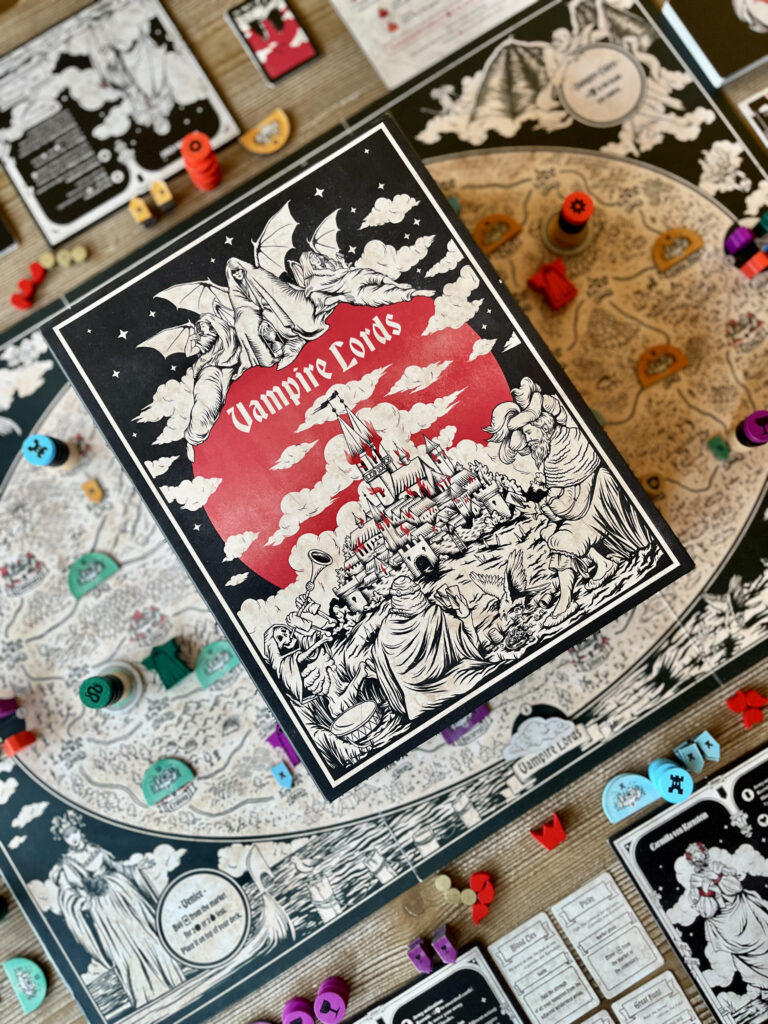
I do not give that praise lightly. I am skeptical of any game that claims kinship with Root, my forever favorite, the gold standard of asymmetric area control, as far as I’m concerned. Every game that draws inspiration from Root is, in my eyes, guilty until proven innocent. Vampire Lords proved itself to be innocent and exonerated.
The Design
A good way to describe this game might be if Root and Magic: The Gathering had a gothic baby. It plays over four rounds and just exudes atmosphere and personality. Four rounds might sound short, but depending on player count, our games ran two to three hours. That will almost certainly speed up with experience, but the length feels just right. The rhythm of it, with the rising stakes and growing powers, lands perfectly.
The atmosphere owes nearly everything to the stunning black-and-white artwork by designer Weronika Galas, punctuated by striking splashes of color, particularly red. Even the card names and abilities reinforce the setting, pulling you into its brooding world without effort.
The map deserves special mention: it’s not just beautiful, but cleverly designed. It naturally drives conflict, while the process of claiming towns stretches your defenses thin, because of the spacing between these key areas. Managing reinforcements becomes a constant balancing act. If you ignore it, you’ll find your back door wide open, and your opponents ready to take advantage.
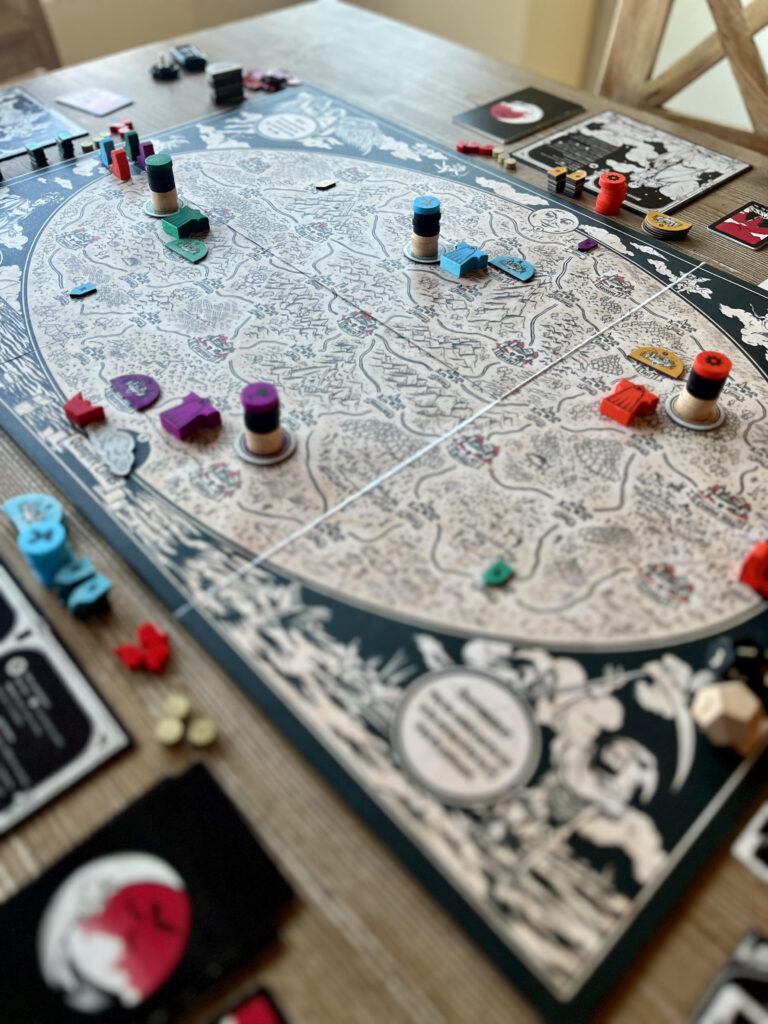
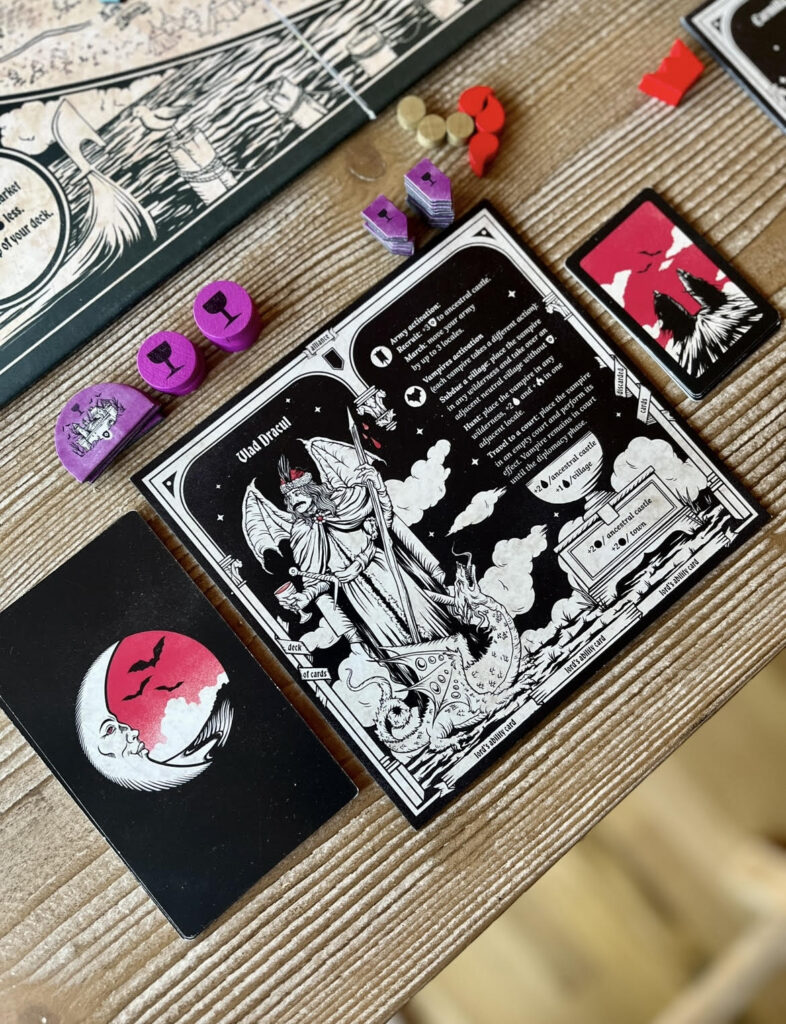
Each player embodies a different Vampire Lord, drawn from myth and history. You might play as Vlad Dracula, a hostage turned ruthless warhawk bent on bloody revenge. His abilities nudge him toward military domination. Or Emine Hatun, the cunning Greek woman who rose through the Sultan’s harem by charm, guile, and sorcery. Her powers lean toward manipulation and diplomacy. Each of the six Lords has a distinct flavor with their own philosophies of power: brute strength, subtle control, opportunism, necromancy etc. Pick your poison.
The Rules
I usually skip detailed rules in my reviews because that’s boring to read, but here, the mechanics are the philosophy. You need the full context to see why this game is so ripe with possibility. So on we press.
Every round begins with Diplomacy. In a four-player game, you can forge alliances. This can be tempting, but potentially costly. Work together, and you’ll control more territory faster, but now you’ll need eight towns to win instead of five. It’s hard to share a throne when you’re power-hungry. Still, breaking an alliance is very much on the menu, but agreements are binding in-game, so be prepared to be held to your word.
Then comes one of my favorite parts: the Lord’s Ability card choice. Each vampire has four immensely powerful asymmetric cards, and each round you’ll add one to your mini-tableau (up to three in play at a time) setting the tone for your strategy. Vlad might double down on warfare, rerolling battle dice, while Emine whispers her way into power with borrowed janissaries to strengthen her army. Afterward, you’ll place your Lord (and in rounds two and four, their vampire spawns) on the map, bolstering armies, influencing battles, and possibly telegraphing your intentions…strategically weighty choices, even this early.
The Action Phase is the heart of the game. You draw 4–6 cards (depending on the round) and play them one at a time in turn order, choosing whether to use their activation symbol (top) or their text ability (bottom). Each card is a tiny decision engine: military symbols let you bolster or move armies, while vampire symbols let you hunt for blood, subdue villages, or visit one of the four powerful Courts. Visiting a Court is a very well-balanced risk. You gain immense rewards, but your vampire leaves the board until the next round. Can you afford to withdraw your power that long? Others WILL take advantage. I have to say, it’s surprisingly poetic for a game where you can also roll dice to turn peasants into soup.
Combat is simple and tense, which, to me, is another huge point in this game’s favor. You play a battle card if you have one, roll two dice, add modifiers, and see who’s left standing. The loser retreats, or becomes dinner. Truly. If you can’t retreat, all your living units get turned into blood currency for the winner. It’s quick and strategic without being bogged down by math. It does have its randomness though, so be prepared for that. The battle cards come in handy here, especially if you absolutely must win.
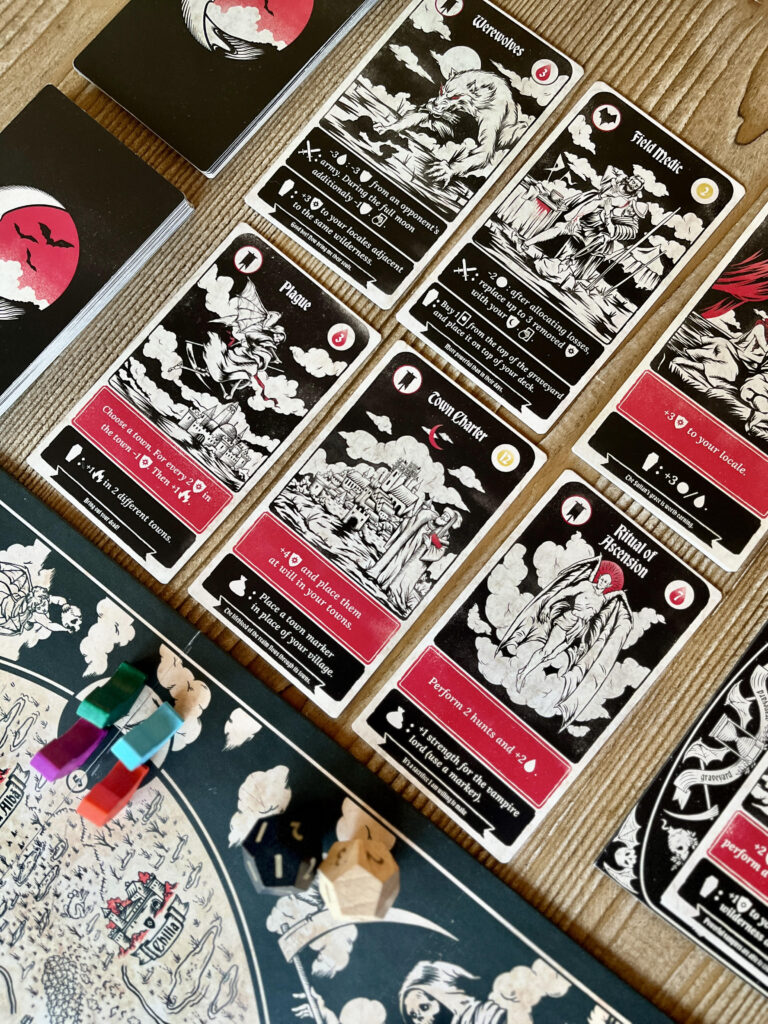
The flow of the game comes together quickly, which is great because now you’ll start to see the deck building side open up. The market offers new cards for the cost of gold or blood (your two resources), with some so strong they feel borderline unfair, until you realize how well everything balances. Sacrificing cards to the Graveyard thins your deck and triggers new boon effects. This is where the combos can start chaining together like wild, and where the Magic fans will feel right at home.
Every card feels powerful, but not unfair. Town Charter can convert a village into a Town…potentially your fifth and final necessary piece for victory, if you can hang on to it through the end of the round. Ritual of Ascension upgrades your Vampire Lord permanently. These moments feel huge, but never broken. The cards are powerful, but well balanced from what I can tell. No one has completely run away with a game because they gained one of these cards, partly because there are more waiting in the wings.
After the Action Phase, whoever passed first becomes first player immediately. This is a clever twist that adds timing tension. Unfortunately, this only matters in three- and four-player games. In two-player, the token just swaps back and forth, which feels like a missed opportunity. Not the end of the world, but slightly disappointing.
Then comes Harvest and Upkeep, where you collect from your towns and villages and pay your armies…blood for undead, gold for the living. Even in undeath, payroll remains a pain *sigh*. And then finally, the Dawn phase. This gives you one more little way to mess with each other, causing unrest in each other’s villages, which ultimately can lead to peasants uprising and overthrowing your control of their town. Chaos is the true companion of power.
If anyone controls five Towns at this point (or eight in an alliance), the sun rises, the game ends, and someone wins.
What’s Missing?
Now, a few imperfections. The rulebook and a few card instructions need tightening. I had to clarify quite a few things, but the designers are aware and already working on edits. The good news is the mechanics themselves are rock-solid. It’s just a matter of writing it out.
We also found there not to be enough army units for players to use. The amount is supposed to be limited. This was not an issue in the two-player game, but it was in the three. My suspicion is that the three-player game is spread out on the board enough that players don’t clash quite as much as the four-player game, and that means players aren’t losing their armies as quickly. It absolutely affected our ability to play cards and pull off certain combos, which was disappointing. It’s a built-in way to not let someone build up an impossibly massive army, but it still felt a touch too tight. Is this something that would change with more plays? I don’t know. Discussing this with the designers though, they are aware and contemplating additional pieces.
The game holds up well at every player count, but two players does lose a bit of that political edge (no struggle for first player and less wheeling and dealing). It is a little more dynamic at three and four, but I’ll still happily play at two any day.
And finally, I see Count Orlok is potentially in the future of the game, but aren’t we forgetting the most horrifying vampire of them all?

Sorry, I had to make the joke somewhere.
For its small imperfections, Vampire Lords does feel like the work of someone who not only understands games, but loves them. It’s polished without being sterile and strategic without losing its soul. The systems mesh together beautifully. You can sense the designer’s hands in every corner, shaping the tension, beauty, and rhythm into something cohesive and alive.
The best games remind you why you fell in love with the hobby in the first place, not because they reinvent it, but because they make it feel new again. Vampire Lords did that for me. Sometimes your game table is a little stage where art, competition, and imagination meet for a few hours. And I feel this one deserves applause after such a great performance.
Thank you to Couple Of Games for providing a temporary prototype. Vampire Lords will be crowdfunding on Gamefound starting November 4, 2025.
The artwork looks awesome! It’s always the 1st thing which had to impress me before buying a game.
This is an amazing, comprehensive, passioned review! I love the art style, theme, and the familiar mechanics. I may gift this one! Thanks!!