
There are many heroic stories in the world, but only one Middle-earth. And much like second breakfast, it has the peculiar quality of never losing its necessity. I’m never sick of it. I return to Lord of the Rings time and time again because I find it truly inexhaustible. It’s grounded in fiction, but echoes a deep human longing for meaningful adventure.
So with the advent of The Two Towers: TTG, I didn’t really need to ask myself if I was ready to return to Middle-earth. I just needed to ask how this particular journey was going to be represented.

What surprised me the most about the first game in the trilogy, Fellowship of the Ring: TTG, was not that it worked, but how respectfully it worked. This is not an IP cash grab. Its design is shaped by affection and humility. Bryan Bornmueller never tried to change or improve Tolkien, but explores what happens when we let the story breathe through mechanics. He continues this exploration in The Two Towers.
I think at least one key theme throughout Lord of the Rings is that ordinary goodness is one of the most extraordinary things in life. This game instinctively seems to understand that. It doesn’t scream its cleverness, but uses the disciplined structure of trick-taking to tell the story of constraint and the weight of choice.
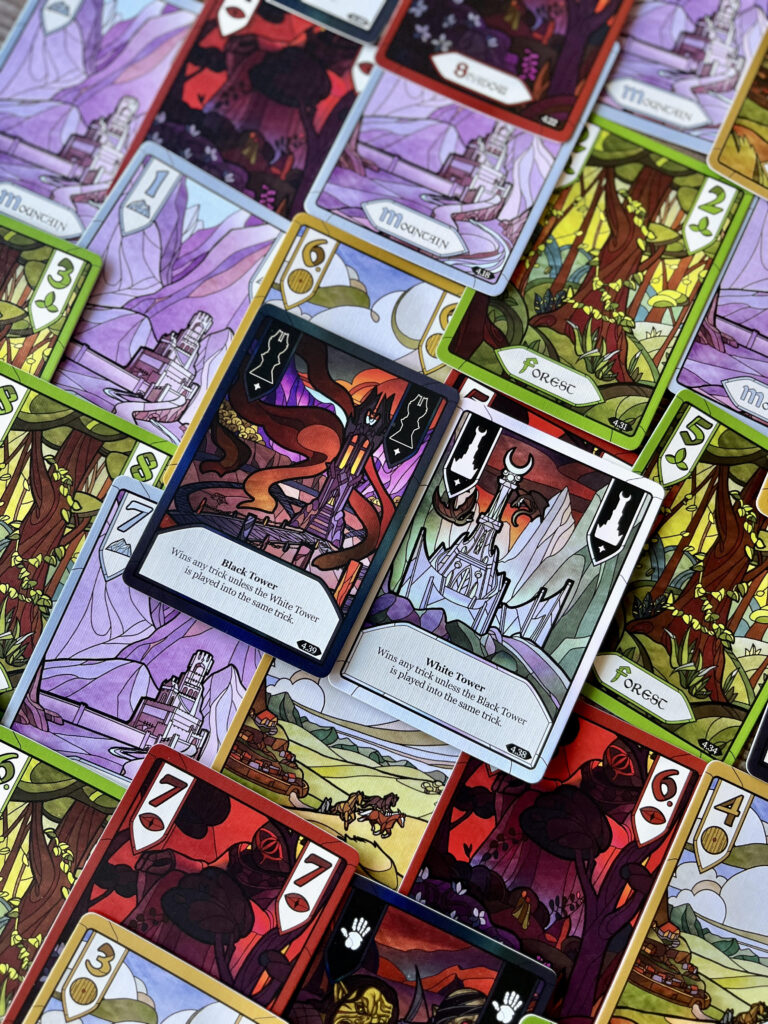
But clever, it is. Chapter after chapter demonstrates what I would say is one of the most creative exhibitions of simple mechanics. The subtle changes start with the Tower cards. A Tower will win any trick it is in, but may only be played if you cannot follow suit. If the White and Black Towers are played in the same trick, they cancel each other out. Beyond that, at least three Orcs cards are shuffled into the deck each round and can only be played if you cannot follow suit. They function as dead weight in your hand. If you are ever forced to lead with an Orcs card, everyone immediately loses the round.
Each character is bound by goals that feel truthful to the story and help navigate the narrative intent.**MILD CHARACTER GOAL SPOILERS FOR PART 1 AND 2** Eomer, for instance, needs to win two or more Orcs cards to meet his goal…simple and effective in telling his part of the story. Other characters might tiptoe around loss and danger but Eomer wants to meet the enemy headon.
Frodo, by contrast, doesn’t fight, but carries. He must deal with a new mechanic called Burden tokens. Here you simply choose one token with a number between two to five, determining how many Ring cards he must win this round. Frodo must bear the Ring, but he must not drown in it. This occasionally subtly interacts with Smeagol, who might need to win more tricks than the value of Frodo’s Burden token, creating tension in their unstable alliance.**END SPOILERS**

This is where the game distinguishes itself from big sweeping epics like War of the Ring. It’s much more intimate. You experience moments with nearly every major character, and for the most part they’re structured in a way that helps advance their plot line or gives a slight echo as to who they are as a person.
To do a little comparison between Fellowship and Two Towers, Fellowship felt a bit too repetitive to me towards the end, and I finished it dragging my feet a little. The Two Towers really seems to stretch its limbs more, drawing on the whole of Middle-earth for its creativity. Part 1 and Part 2 are split between Aragorn, Merry, and Pippin’s storyline and then Frodo, Sam, and Gollum’s. This structural contrast really worked for me. It gave me time to explore all the characters of Part 1 and gain confidence with them, and then shift to new characters with new focuses. The widening world comes across well.
It’s still a trick-taking game at its bones. You follow suit, anticipate, and calculate. But the cooperative nature and narrative basis give it a bit more meaning.

The Orcs cards are a good example of this. It introduces rising stakes and a bit of fear into the story. Again, a simple mechanical choice that lightly shapes the emotional side of play. When is the best time to get rid of it? It might require a sacrificed trick win on your character’s part. Only once did I lose a round because I was forced to lead with an Orc card, but when you take that on top of all the other scenario goals, the considerations begin to add up quickly. The chain reaction of difficulties stack up.
The chapters all vary beautifully, each asking something slightly or dramatically different of the player. There’s always precise timing, but it’s mixed in with intentional inefficiency and attempting to control loss. Some chapters are much more complicated than others and quite thinky. One early mechanic (which I refuse to spoil) completely won me over and basically shaped my opinion of the design.
Difficulty is a touch higher than in Fellowship, especially solo. We/I failed often. But with chapters running roughly fifteen minutes, its not really a hassle to persevere and try again. Which is, if you’ll pardon the poetry, rather the point anyways.
If you didn’t like Fellowship, you probably won’t care for this one. But if you did, even if you were a little tired of Fellowship towards the end, I can attest that this one freshens things up. Between the two, I prefer The Two Towers. Bornmueller has improved the game with even more variety and challenge, and I think that’s pretty cool.
And so I look forward to returning to Middle-earth in new ways. It’s a steady rediscovery of something good and familiar. The Two Towers: TTG did an excellent job reminding me why the journey is worth walking again. Great stories and good games don’t grow stale, but deeper. And I’ll be happy to return for the third installment.
Thank you to Office Dog Games for the preview copy.