
Because this is an older game, I’m going to assume some understanding of the rules and not use this review to explain them. However, I will discuss the differences in the expansions.
There are games for storytellers and there are games for spreadsheet lovers and this one definitely leans towards the latter. Which brings me to a little story: a funny thing happened to me, which is that, after a lifetime of various romantic partners, I finally got my first ever boyfriend who was a math lover. Not professionally. Not under duress. I mean “into it” in that, not only did he major in it, but he also likes to casually check the gravitational pull of his coffee cup, and understands concepts I can barely pronounce…
Reader, I married him. And this guy, he is the target audience for this game.
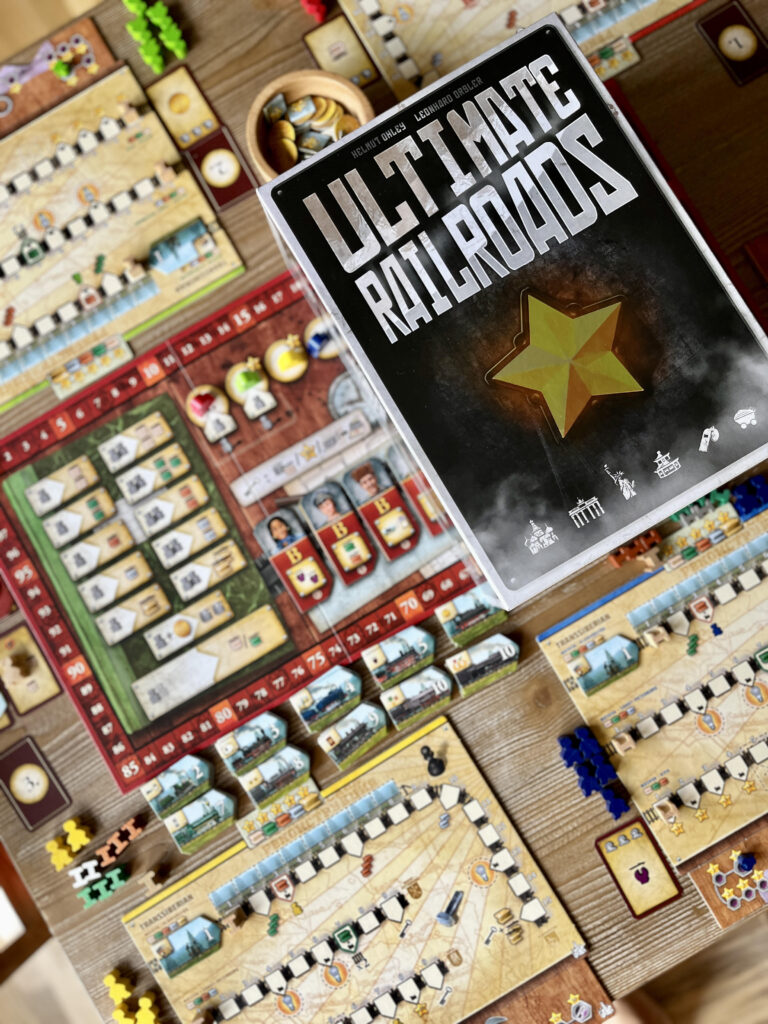
What’s interesting, though, is that I am decidedly not a math gal. I am decidedly someone who prefers a bit of story or theme in my games. And yet, I am also decidedly in love with this one. I only have so much shelf space in my heart and home for the “mostly-pure worker placement” Euro crowd. Agricola and A Feast for Odin will probably forever hold the first two spots, but in a fit of boldness (or what you might call “the bravery of boredom”) I might just declare this one number three.
People tease this one for its shaky theming. But the funny thing is, even though the story’s a little…loose…it still feels like a game about trains. It’s not so abstract that I lost track of my purpose, though I did relay the same section of rail five times without asking why, which made me realize I’d probably thrive in middle management. But the rhythm builds; the meta feeling of the game is that it starts to accelerate, its engine using its own momentum to carry you right to the end of the track.
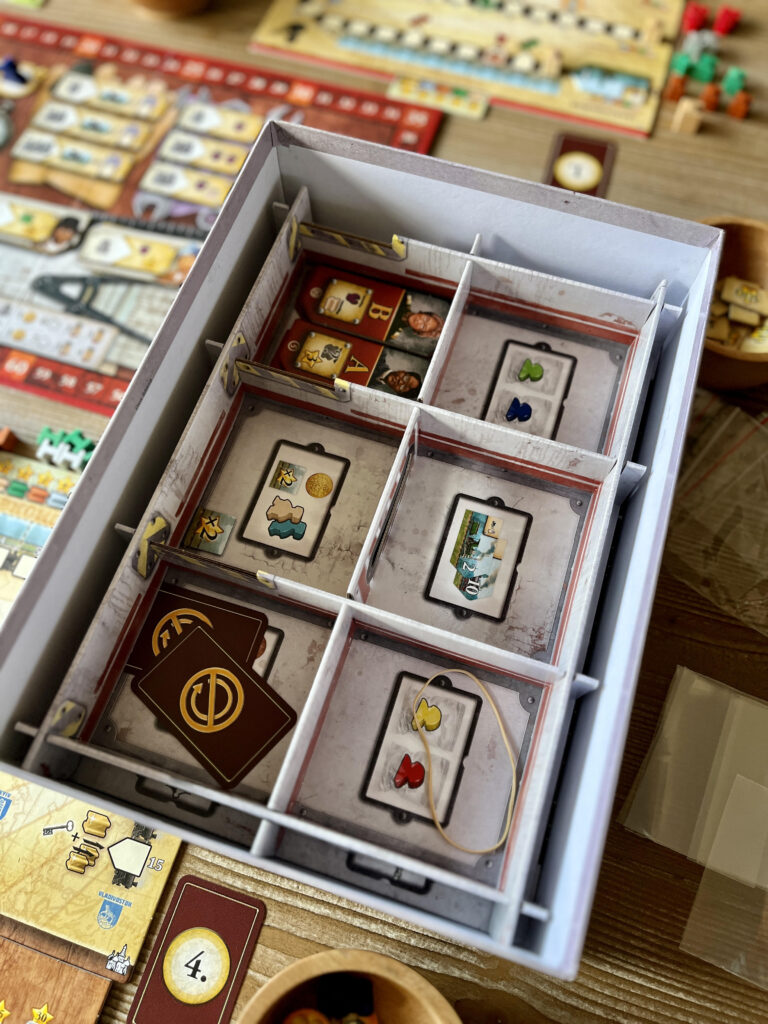
The box itself is a small marvel of German precision. It’s got two layers of cardboard wells to organize the expansions and modules. The components sometimes migrate to the neighboring wells, and the storage bags never quite fit their assigned spots, but at least the lid closes flat, so my mild OCD is mostly satisfied.
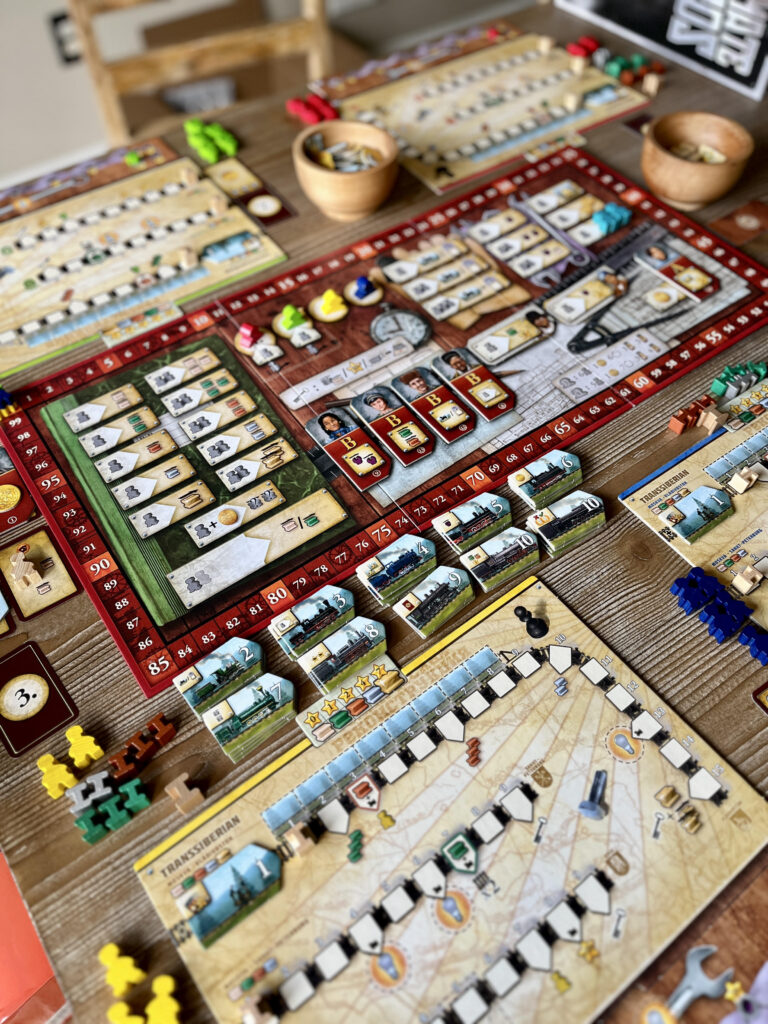
The artwork probably won’t stun anyone, but it’s of its time, and I suspect one day I’ll look at it with the same affection I reserve for flip phones. It’s outdated, but strangely comforting.
Ultimate Railroads hits me in a similar way to Agricola, with tight worker placement and agonizing decisions. But it’s a little less punitive and less complex without all the card variance. And it lets the point salad go much more wild. And I’ll say this is point salad and not point salad at the same time. It’s a disciplined salad. You need to plan or the points definitely won’t rack up in the way that they could.
Something about this game just drives me. I sort of accept that what might take the more math-brained souls five games to optimize will take me fifty, but it’s fifty that I’ll gladly pay. The decision space isn’t too broad that I lose the plot. I can focus, pivot, and feel clever without actually being clever. Which, honestly, is the best kind of illusion.
This might make you concerned if you do fall among the math-brained spreadsheet lovers. Will you optimize this too quickly and lose interest? Based on the sea of glowing reviews, the answer is no. At least, it’ll take many, many games. Russian Railroads alone has serious staying power. The random engineers and player choices make each game distinct enough that it’s not solved or scripted (although I cannot seem to get away from the importance of engineers/coins if I have the opportunity). If you only ever played against ME, crushing me by 200 points each game, then that might get a little old, but luckily you don’t have to do that (well, I do have 5 games of this going on BGA right now so I guess some people have to).
German Railroads
What an excellent addition this is. It doesn’t reinvent the wheel (or the rail), but it polishes it beautifully. Germany adds a few clever twists that dramatically extend the game’s life. This takes the potentially limited lifetime of Russian Railroads and throws it straight out the window. The new player boards let you pick from 18 railroad extensions, each offering unique bonuses. Some of these bonuses include income tiles that give you a specific boon each round, such as an extra coin or industry track move. This is a lot of fun because you can choose something that helps drive you further towards your strategy.
Mixing and matching the extensions gives the game near-endless replayability. On top of that, the board features a split track where you must choose between pursuing the prestigious gold track route or taking a faster, humbler path with smaller bonuses and no gold track option. The best part is all this variety comes with such low rules overhead. I’d happily teach Germany Railroads as the first way to play, at least to experienced gamers.
American Railroads
Next stop: American Railroads! This expansion is where the theming is a bit more ambitious and it does let me down a little. The stock market really does not resemble a stock market in any way, and is more just a separate track to climb. It’s not that complicated, and it’s also not that interesting. It’s fine with three or four players, and so I would really only play this expansion at those player counts.
Still, it does have several new elements I enjoy. You can now place all five track colors wherever you please (though you’re still limited in how many silver and gold tracks you can use). This freedom adds flexibility and fun decisions. Each track can hold doubler tokens, and connecting your two bottom tracks with the golden spike yields a massive 50-point bonus every round. There’s also a dual industry track, which can be incredibly powerful if you plan early. There are no new wrench actions on the board so you need to be on it from the get go. In short: more levers and tinkering and still satisfying.
Asian Railroads
And we finally reach our final train route: Asian Railroads. As far as I’m concerned, the stories are true. This is my favorite way to play Ultimate Railroads. The player boards are my favorite bit about this expansion. There are so many new benefits, including an entire route upgrade. If you choose the specific idea token, you immediately place the Osaka route overlay on your board, allowing for higher colored tracks and better bonuses.
It also comes with the new concept of a shared industry board. This allows for new ways to directly interact with players and once again, provides even more replayability. This expansion has taken me the longest to channel myself towards some kind of strategy, because I chaotically want to take advantage of everything every time I look at the player board. Paying close attention to the industry track seems critical and I’m still working on consistently aiming to get that second wrench into play.
Modules
The modules are a bit of a mixed bag for me. The Coal expansion adds a new resource and a lot of overhead, and not enough fun for the tradeoff. It really changes how the game is played, and is really the only way actions on the board change. It also makes the game one round shorter, to balance the powerful actions it allows. I will pretty much never play with this module unless someone specifically requests it, and has experience with the game.
The Manufactory Train Module, on the other hand, is wonderful. It gives a separate worker placement space that grants three bonuses. What’s nice about this is whenever someone uses this space, everyone else gets one bonus as well, making it an almost shocking act of generosity in an otherwise completely cutthroat game. It does change the calculation on the engineers/coin spaces at the beginning of the round because being the one to gain three bonuses is very strong. In fact, it’s strong enough that it’s also balanced by making the game one round less.
There are also extra engineers and idea cards, which I always shuffle in. More variety is never a bad thing.
As for the solo mode: it’s serviceable, driven by an automa named Emil who is driven by a deck of cards. He is specifically designed to block. If you draw a space that you aren’t able to make use of yet, you must draw another card, until he does get in your way. He is also able to work with any of the expansions and modules. He doesn’t score points, just blocks the spots you want. It’s clever and functional. But it does lack that spark of human unpredictability that makes tight worker placement games thrilling. Solo is fun to get practice reps in, but this is a game that’s definitely meant to be lived in the company of others.
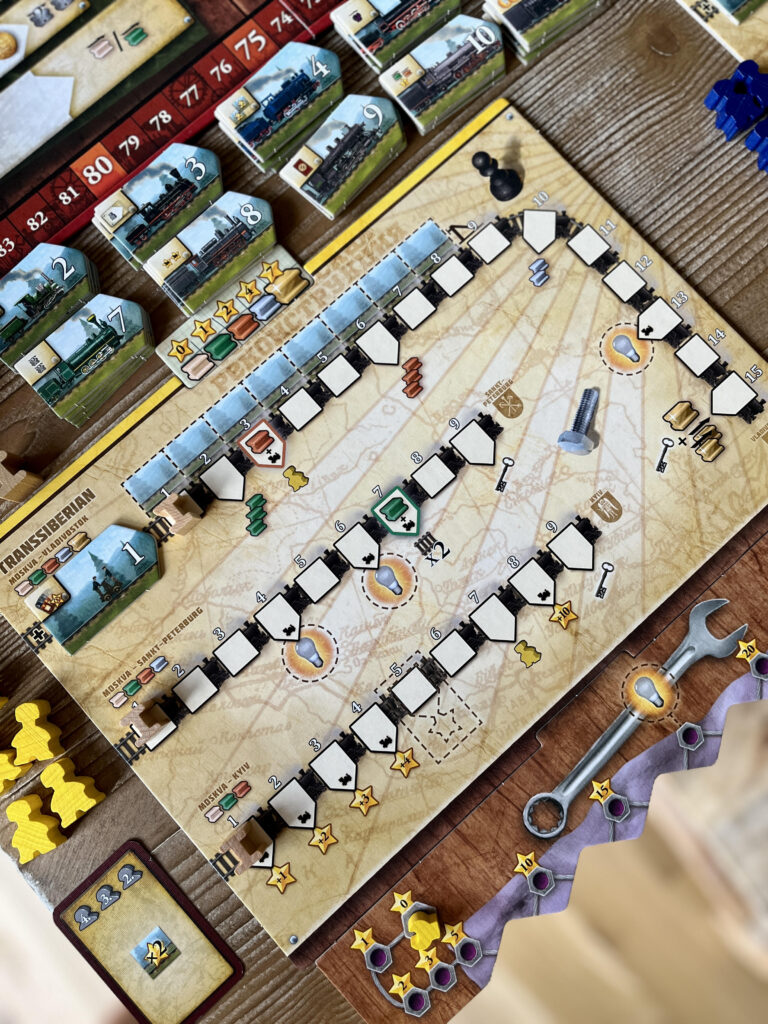
Ultimately, Ultimate Railroads is a completely absorbing puzzle from beginning to end. You’ll obsess over efficiency with every placement, which may or may not be a selling point. It’s stressful, like Agricola, but without the guilt of feeding your starving cardboard family at the end of each round.
The only real drawback is how punishing it can be for new players. If you fall behind early, it’s a long, humbling ride to the finish line. But for those willing to lean in, the game offers the chance to see the music in the math, and turn it from something scary into something more fun and accessible. I’m all about transcending numbers.
There’s almost a bit of romance in turning something very mechanical into something meaningful. And the human persistence that it took to build all these railroads in real life is reflected here in this game. I constantly have the desire to make one more efficient choice and lay one more line of track. For all its cold efficiency, it somehow warms me every time I play.
Thank you to Z-Man Games for the review copy.