
I love The Hobbit for many reasons, one of those being that JRR Tolkien’s writing imprinted itself on the deepest core of my brain and soul when I was at a tender age. That story has never really left me. And I suspect many people drawn to this game feel something similar. So I’m happy to say right from the start: a great deal of care has gone into capturing the warmth and whimsy of that world, even if I do have a few caveats along the way.
Originally, I started off jotting down thoughts after finishing the entire game solo, and the review was leaning pretty critical. The number of turns in many chapters felt too tight and unforgiving, and I was left wondering if I was missing half the game. But then I played it multiplayer, and what a difference that made. Truly a different game. It’s almost as if Bilbo was meant to step out of Bag End with companions at his side.
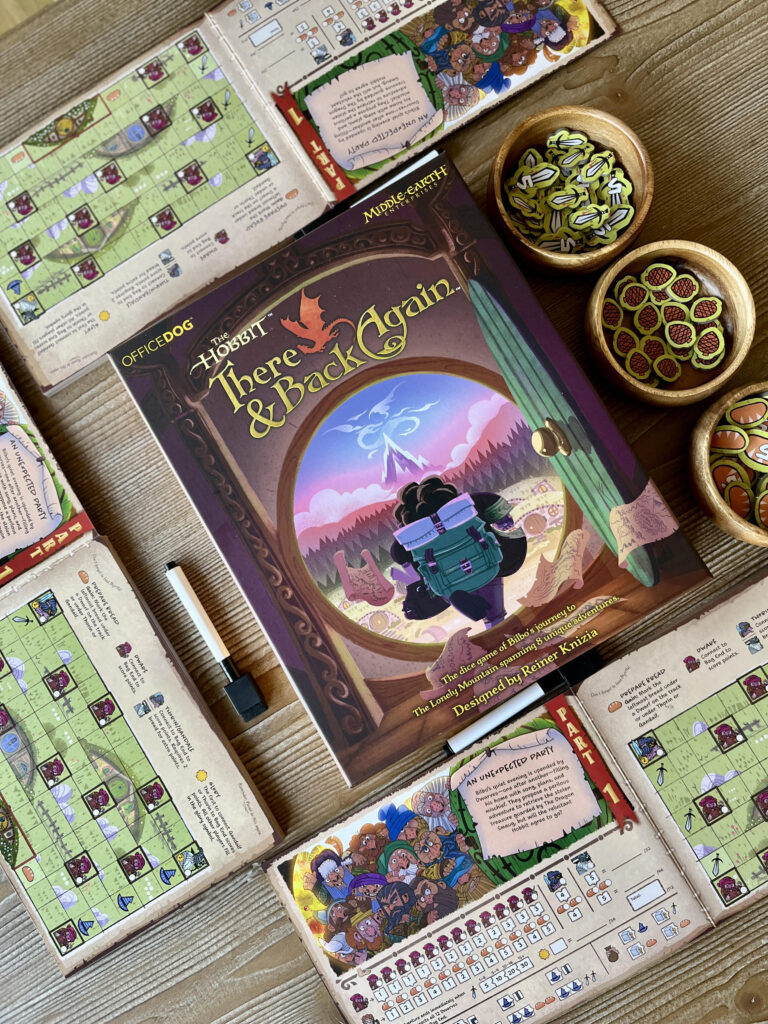
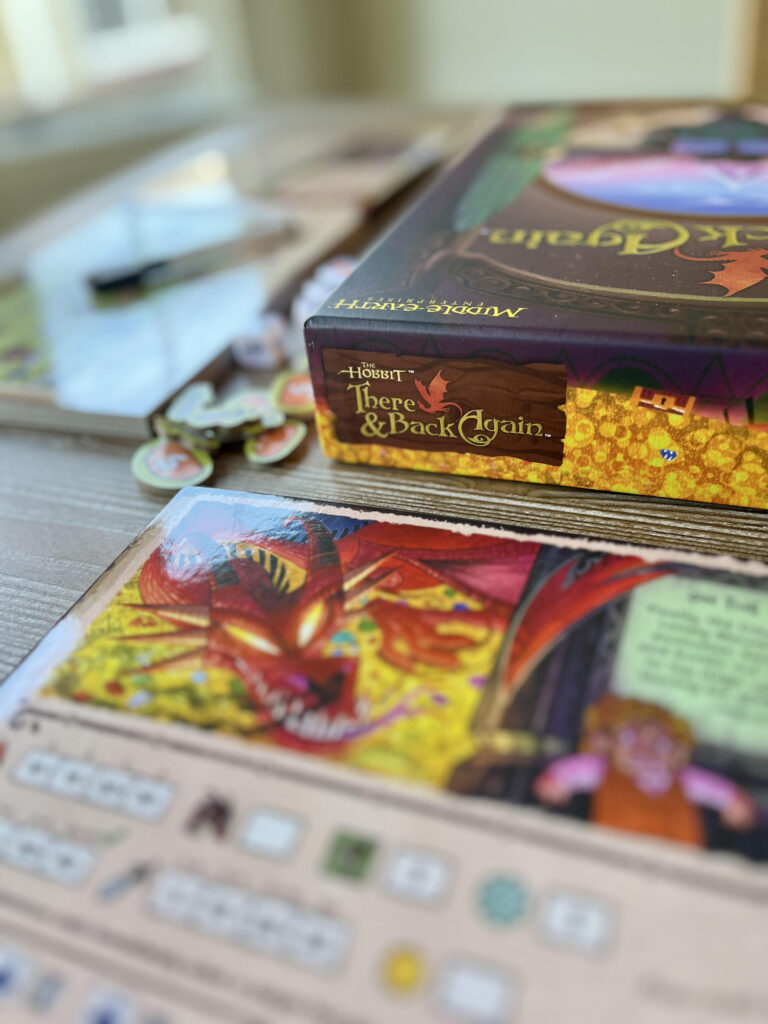
Before I get into those details though, it needs to be said that the production of the game is truly exceptional. The cartoony look works because it captures the spirit of The Hobbit as a book for children, but never feels childish. On top of that, the laminated board book is functional, lying flat on the table without a fuss. And the cardboard resources are much chunkier than your average board game cardboard. The whole thing sets the tone perfectly, with a tactile charm that matches the warmth of the book.
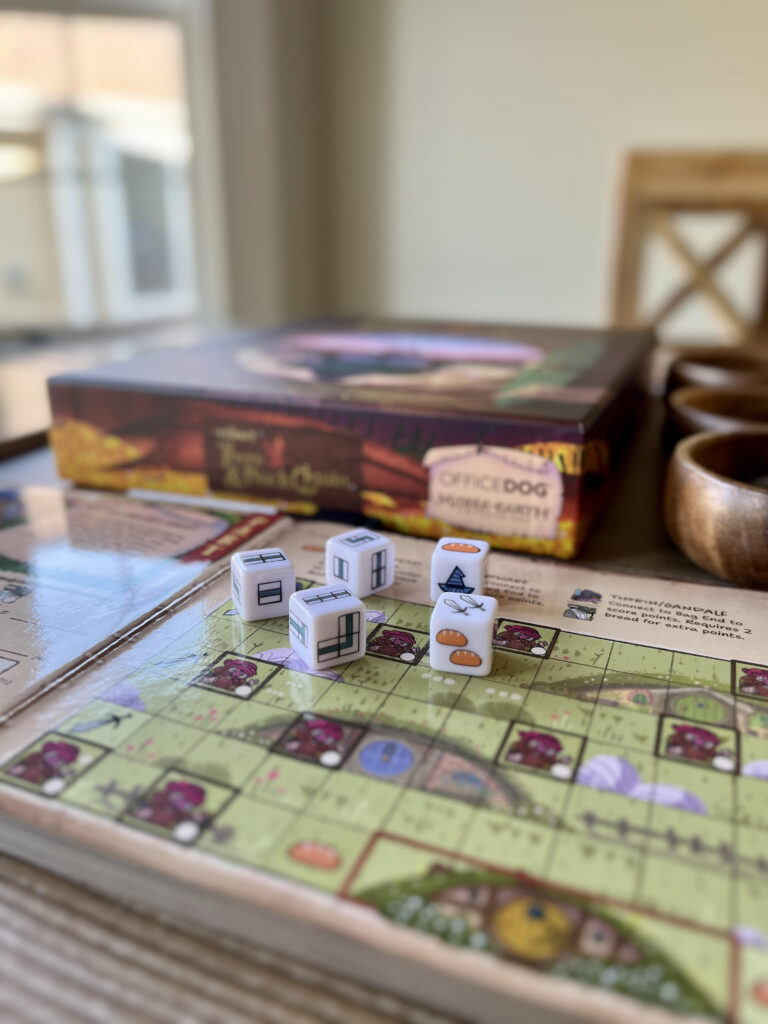
You’ll play through eight chapters, with each carrying you through a scene in the story. The rules themselves are simple. You roll a set of dice: three white dice give you the shapes of the path you must draw on your grid, two white dice provide resources (bread, swords, wizard’s hats) and the black die, a twelve-sider, shifts its purpose depending on the chapter. Each scenario riffs on this same framework, but with very different goals and uses of resources.
And that’s Knizia for you…creative variety without ever overcomplicating things. Eight hundred games later, he knows better than ever how to stretch a small system into something fresh. I’m also quite relieved he resisted the urge to include a chapter about a doomed fanfiction love triangle between an elf and dwarf (something that still begs the question: WHO’S OPTIONED THIS???)
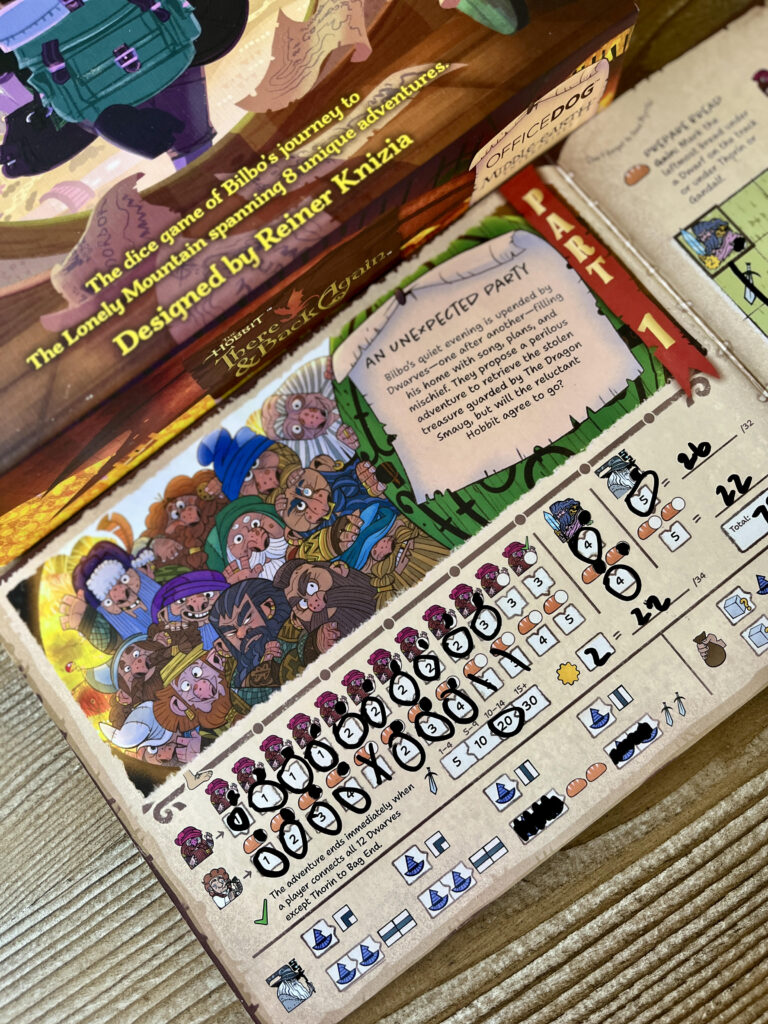
For instance, the first chapter. Your goal is to help all twelve dwarves (plus Thorin and Gandalf) reach Bag End, ideally feeding them bread along the way. It’s straightforward but surprisingly replayable. I’ve played it five times now and still feel like I can do better. In multiplayer, the chapter ends when the first person connects all twelve dwarves, and my best score so far is 95 out of a possible 112. It’s a light race that rarely feels too rushed. Everyone’s usually more interested in optimizing their routes, collecting resources, and seeing how far they can push their own plans before someone decides to wrap things up.
Solo, though, you’re locked into eight turns. If you manage to connect all twelve dwarves you get a sweet 20-point bonus, but pulling that off means neglecting other opportunities. The highest I’ve scored is 74 and haven’t been close to connecting all 12. It puts a much heavier focus on racing the game.
That’s really the key difference: in multiplayer, nobody I’ve played with is just gunning for the end. The endgame trigger might still matter, but it’s rarely anyone’s main goal. The endgame bonus in multiplayer is worth next to nothing compared to other ways to score, so it’s not really designed as a sprint, as far as I can tell. It’s more like a cherry on top after everyone’s had the fun of exploring the chapter, gathering points, and trying out their own little paths through Middle-earth. Which makes me wonder why the majority of the chapters in solo mode feel restrictive. It almost feels like a different game, and one that doesn’t quite let you appreciate how clever each scenario is.
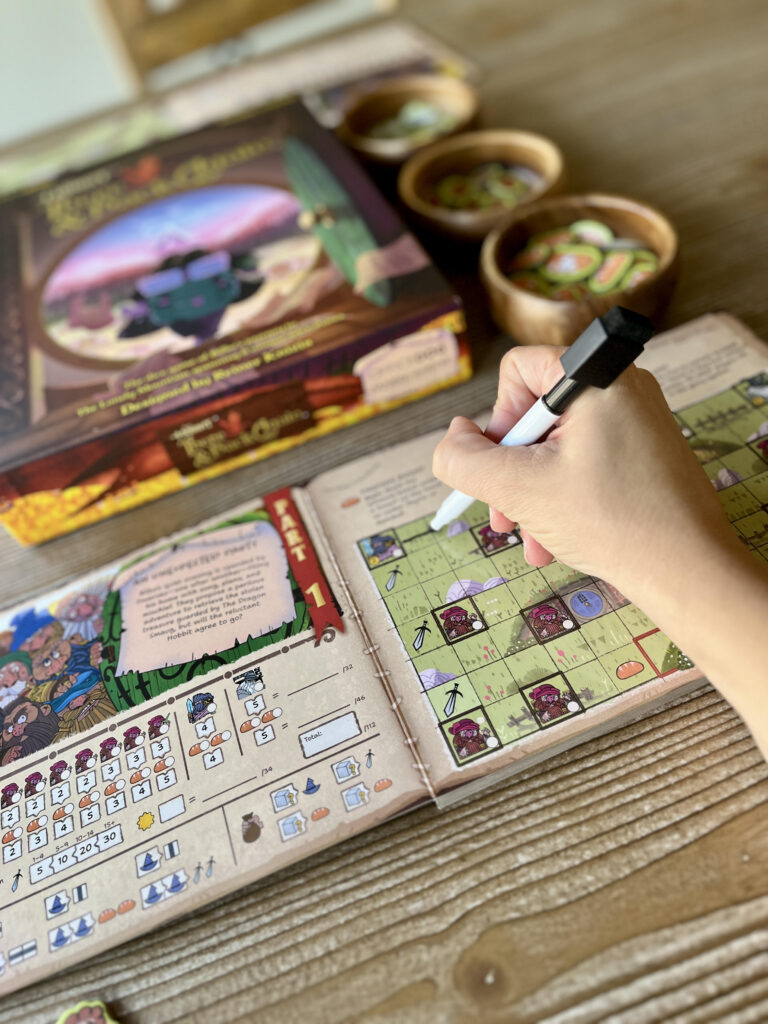
And each chapter is so unique. Not a single one feels phoned in, even if there are some I personally prefer over others. It’s where Knizia’s hand is most obvious to me. You can see his signature balance of structure with room for experimentation. He just knows exactly how far to stretch a system without breaking it.
This feels like a game meant to be explored, not rushed. And multiplayer lets you do exactly that. Timing the ending is its own strategic game. You need to watch how close others are, try to estimate their points, and sometimes end things early to keep them from hitting the next big point threshold. But the real fun of it lies in gathering resources to work towards the goals you want to complete, the dice drafting table talk, and the competition that gains in strength as everyone’s map fills in.
That’s not to say the solo game doesn’t have its charms. It’s genuinely fun to see how cleverly each chapter is constructed, and it offers a real challenge. Several chapters do give you enough rounds to feel satisfying, those primarily being chapters 5, 6, and 8. But the rulebook provides no benchmarks or scoring scales, so it’s hard to know if your score is impressive or just okay, and after several plays I found myself circling the same range of results with no clear sense of progress.
Chapter 3 especially feels punishing in solo mode. A few unlucky rolls can leave you without bread, and that can grind you to a halt in a certain section. There are ways around it, but they come with steep efficiency penalties. A few of the solo game chapters depend on luck in a way that’s not particularly enjoyable. You don’t get much breathing room for bad luck if you’re aiming to improve your scores. This can ultimately be a knock against its replayability, because at a certain point, improvement will come down to luck. In multiplayer, that variance fades into the background a little more, and made chapter 3 much more enjoyable for me, in particular.
One small quirk I noticed is that the solo round tracker lives in the rulebook. It’s not a big deal, but it does make setup a little clunkier than it needs to be. Having the rulebook open beside the game takes up extra space, and flipping back to check the chapter rules means moving the tracker out of the way each time. It would’ve felt a bit smoother, and more in line with the game’s otherwise thoughtful presentation, if that tracker had been included in the Adventure Guide instead.
Even with those critiques though, I’ve thoroughly enjoyed every scenario, both solo and multiplayer (although I’ve found myself starting to dislike solo Chapter 3 the more I play). I’ve played each of the eight chapters three to five times and could easily play more, but I’ll lean more towards multiplayer now. That says a lot for a medium-light game. The question really isn’t enjoyment. It’s just about who the game is best for. If the theme doesn’t pull you in and you’re after a crunchy solo challenge, something like Welcome To The Moon might scratch that itch better. But if you want a game that feels charming and varied and tells a little story each time you pull it out, this is a wonderful choice…and not once will you have to sit through a dwarven love confession.
Thank you to Office Dog Games for the review copy.
I have been enjoying different LOTR games. This looks like a good game for the same story line!
It’s worth the 50 points if you finish in 8 turns while playing the hard mode. I never come close to these points if i try to finish other quests.
I still have this one in shrinkwrap… hopefully today is the day!
Love this game
Love this game love the story telling of it